
It is invisible to the naked eye. It leaves no obvious trace in the environment. And in many dogs, it causes no symptoms at all, at least not initially.
Cryptosporidium is a microscopic protozoan parasite that lives and multiplies within the cells lining the intestinal tract. Its ability to establish itself quietly, persist in the environment, and cause persistent gut disruption in vulnerable dogs makes it one of the more underestimated intestinal parasites in veterinary medicine. The danger is not dramatic. It is cumulative. And in puppies or immunocompromised dogs, what begins as watery diarrhoea can escalate to severe dehydration and serious illness before owners recognise the pattern.
Understanding what this parasite is, how it operates, and when it demands veterinary attention is essential knowledge for anyone caring for dogs, particularly in environments where multiple animals share space or where access to clean water and sanitation cannot always be guaranteed.
What This Parasite Really Is
Cryptosporidium is not a worm. It is not a bacterium. It is a protozoan, a single-celled microscopic organism that belongs to a group of intestinal parasites distinct from the more commonly discussed roundworms, tapeworms, and hookworms.
The disease it causes is called cryptosporidiosis. The parasite lives inside the cells lining the small intestine, where it completes its lifecycle, produces new infectious forms, and disrupts the absorptive function of the gut in ways that produce the characteristic watery diarrhoea associated with infection.
What makes Cryptosporidium particularly challenging is its resistance to many standard disinfectants and its ability to persist in the environment for extended periods. The infectious stage of the parasite, called an oocyst, is shed in the faeces of infected animals and can survive in water and soil for months under the right conditions. Standard chlorination of water does not reliably inactivate it.
Early and Advanced Signs You Might Notice
One of the complicating features of Cryptosporidium infection is that the range of clinical presentation is broad, from completely silent to genuinely serious.
- Watery diarrhoea is the most consistent sign in symptomatic dogs. It may be acute and severe or chronic and intermittent, and it is rarely accompanied by blood in straightforward cases
- Dehydration develops rapidly when diarrhoea is persistent, because the gut’s ability to absorb water and electrolytes is directly disrupted by the infection
- Weight loss follows chronic or recurrent infection as the absorptive capacity of the small intestine is progressively compromised
- Lethargy and reduced appetite reflect the systemic impact of ongoing fluid loss and intestinal inflammation
- Asymptomatic carriage is common in healthy adult dogs, where the immune system contains the infection without producing obvious clinical signs. These dogs can shed oocysts in their faeces and act as sources of infection for more vulnerable animals without showing any illness themselves
The silent carrier state is particularly relevant in multi-dog environments, including shelters, breeding kennels, and households with multiple dogs, where an adult dog that appears healthy may be continuously seeding the environment with infectious oocysts.
Where It Comes From: Contamination Pathways
Dogs acquire Cryptosporidium through ingestion of the oocysts, most commonly through the following routes.
- Contaminated water is the primary transmission vehicle. Puddles, ponds, streams, and any standing water that may have been contaminated by the faeces of infected animals can carry oocysts. This is a significant risk for dogs that drink from outdoor water sources
- Contact with infected faeces during normal sniffing, grooming behaviour, or environmental exploration allows oocysts to be ingested directly
- Contaminated food prepared with or stored near sources of faecal contamination can carry oocysts
- Environmental persistence means that even an environment that appears clean can harbour viable oocysts for extended periods after an infected animal has been present. The oocysts are resistant to drying, low temperatures, and many standard cleaning agents
Related Videos



How This Parasite Takes Over the Gut
The mechanism by which Cryptosporidium produces its characteristic pattern of illness is worth understanding in detail, because it explains why supportive care rather than antiparasitic drugs is the foundation of management for most cases.
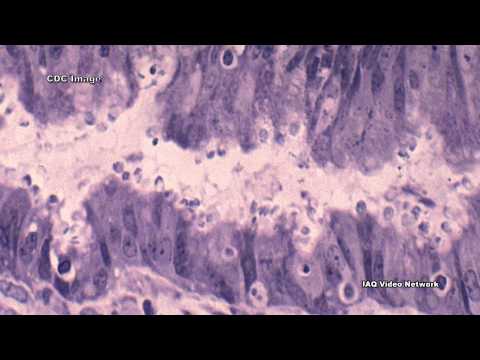
When a dog ingests oocysts, the outer wall of the oocyst breaks down in the small intestine and releases the infective forms inside. These forms, called sporozoites, attach to the surface of the epithelial cells lining the intestinal wall. Crucially, they do not penetrate deep into the cell. Instead, they establish themselves in a unique intracellular but extracytoplasmic location, sitting within the cell membrane but not inside the cell’s interior. This positioning partially shields them from the immune response and from drugs that act within the cell.
Once attached, the parasite undergoes rapid multiplication within this location, producing new generations of infectious forms that either infect adjacent cells or are shed into the gut lumen in the faeces as new oocysts. This multiplication damages the microvilli, the tiny finger-like projections that line the intestinal surface and are responsible for the vast majority of nutrient and water absorption.
Damaged microvilli cannot absorb efficiently. Water and electrolytes that would normally be extracted from the gut contents pass through instead, producing the watery diarrhoea that characterises cryptosporidiosis. As diarrhoea continues, fluid and electrolyte losses accumulate. In a healthy adult dog with a competent immune system, the infection is typically self-limiting. In a puppy or immunocompromised dog, the fluid losses can reach a level that produces dangerous dehydration.
Different Forms of Infection
Not every dog with Cryptosporidium presents the same way, and recognising the different forms helps owners and veterinarians assess severity accurately.
Asymptomatic infection is the most common form in healthy adult dogs. The dog sheds oocysts, may have been exposed repeatedly, and shows no clinical signs. The infection is typically only discovered incidentally through faecal testing for another reason.
Acute symptomatic infection presents with sudden onset of watery diarrhoea, which may be profuse. In otherwise healthy dogs, this typically resolves within one to two weeks as the immune response brings the infection under control.
Chronic persistent infection occurs primarily in dogs with compromised immunity, whether from underlying disease, concurrent infection, stress, or immunosuppressive medication. These dogs cannot mount an effective immune response to contain the infection, which continues to damage the intestinal lining over an extended period, producing ongoing diarrhoea, weight loss, and progressive debilitation.
Why Puppies and Weak Dogs Are More at Risk
The severity of cryptosporidiosis is directly linked to the competence of the immune system, which explains why certain dogs are disproportionately vulnerable.
- Puppies have immune systems that are not yet fully developed, and their smaller body mass means that the same degree of fluid loss from diarrhoea produces proportionally greater dehydration than in an adult dog
- Dogs with concurrent infections, including parvovirus, distemper, or other intestinal pathogens, face a compound challenge in which Cryptosporidium adds to the existing damage and immune burden
- Stressed dogs, particularly those in shelter environments, breeding kennels, or recently rehomed situations, have cortisol-mediated immune suppression that reduces their ability to contain the infection
- Dogs on immunosuppressive medication or those with conditions that impair immune function are at risk of chronic, severe cryptosporidiosis that does not resolve spontaneously
How Vets Detect Something So Small
Diagnosing Cryptosporidium infection is technically more demanding than detecting larger parasites such as worms, for reasons directly related to the parasite’s microscopic size and its pattern of shedding.
- Faecal examination using specialised staining techniques, particularly modified acid-fast staining, allows the small oocysts to be visualised under a microscope. Standard faecal flotation techniques used for worm eggs are insufficient to reliably detect Cryptosporidium oocysts
- ELISA antigen testing detects Cryptosporidium proteins in faecal samples with greater sensitivity than microscopy alone and is the preferred diagnostic method in many veterinary laboratories
- PCR testing provides the highest sensitivity and specificity and can detect the parasite’s genetic material even at very low levels in the sample, making it the gold standard for diagnosis particularly in cases where oocyst shedding is intermittent
- Repeat testing is sometimes necessary because the parasite is not shed continuously, and a single negative result does not exclude infection in a dog with a clinically consistent presentation
Treatment Approach: Why Supportive Care Matters Most
The management of cryptosporidiosis in dogs reflects a reality that is important for owners to understand. There is no universally effective antiparasitic drug that reliably eliminates Cryptosporidium from the gut of an infected dog.
In healthy dogs, the infection is self-limiting and the immune system resolves it over one to two weeks. Treatment in these cases focuses on supporting the dog through the period of illness rather than directly killing the parasite.
- Fluid therapy is the most critical intervention, replacing the fluids and electrolytes lost through persistent diarrhoea. Oral rehydration solutions are appropriate for mild cases. Intravenous fluid therapy is required for moderate to severe dehydration
- Anti-diarrhoeal and gut-protective medications reduce the rate of fluid loss and support intestinal healing
- Nutritional support with easily digestible food maintains caloric intake during the period of reduced absorption
- Isolation of symptomatic dogs in multi-dog environments prevents further environmental contamination and protects other dogs from exposure
Several antiparasitic drugs have been investigated for use against Cryptosporidium in dogs, but none have demonstrated consistent efficacy across clinical cases. Treatment decisions in individual cases are guided by clinical severity and the dog’s immune status.
Related Products



What Recovery Looks Like in Real Cases
The prognosis for dogs with cryptosporidiosis is closely tied to their immune status at the time of infection.
Healthy adult dogs with acute symptomatic infection generally recover fully within one to two weeks with appropriate supportive care. Their immune systems contain and resolve the infection, and lasting intestinal damage is uncommon.
Puppies with significant diarrhoea and dehydration require prompt veterinary intervention. With timely fluid support and appropriate management, most puppies recover, but the window between manageable illness and life-threatening dehydration is narrow and closes quickly.
Dogs with chronic cryptosporidiosis secondary to immunocompromise face a more guarded prognosis. Managing the underlying immune problem, where possible, is the most important factor in determining whether the intestinal infection can ultimately be brought under control.
Reinfection is possible because exposure to environmental oocysts is difficult to prevent completely in dogs with outdoor access. Dogs that have recovered from one episode are not protected against future infection.
Complications That Can Turn Serious
While most cases in healthy dogs are self-limiting, certain complications can make cryptosporidiosis genuinely dangerous.
- Severe dehydration is the most immediate life-threatening complication and the primary driver of fatality in vulnerable dogs. Fluid losses from persistent watery diarrhoea can exceed what a puppy or small dog can compensate for physiologically within hours
- Malnutrition and chronic weight loss develop in persistent infections where the damaged intestinal lining cannot absorb adequate nutrients even during periods of reduced diarrhoea
- Chronic intestinal damage from prolonged infection leaves the intestinal mucosa structurally compromised, increasing susceptibility to secondary infections and reducing absorptive capacity on a lasting basis
Understanding the full spectrum of intestinal conditions that can affect dogs, from parasitic infections to structural diseases, is an important context for interpreting gut-related symptoms accurately.
Cryptosporidium vs Other Intestinal Conditions
| Condition | Type | Primary Damage | Key Symptom | Treatment Focus |
|---|---|---|---|---|
| Cryptosporidiosis | Protozoan parasite | Microvilli damage, malabsorption | Watery diarrhoea | Supportive care, hydration |
| Giardia | Protozoan parasite | Intestinal lining disruption | Soft to watery diarrhoea | Antiparasitic drugs |
| Worm infections | Helminth parasites | Mucosal damage, blood loss | Variable diarrhoea, weight loss | Anthelmintic drugs |
| Intestinal leiomyoma | Smooth muscle tumour | Structural obstruction | Vomiting, obstruction signs | Surgery |
The distinction between a parasitic infection causing functional malabsorption and a structural condition like an intestinal tumour causing physical obstruction is an important one that shapes the urgency and nature of the veterinary response. Functional diarrhoea from parasitic infection and mechanical obstruction from a tumour may overlap in some symptoms but require entirely different management approaches.
Similarly, understanding the range of parasitic organisms that can affect dogs beyond the familiar intestinal worms, including unusual pathogens such as flatworm parasite infection in dogs, illustrates why accurate diagnosis matters so much when a dog presents with persistent gastrointestinal signs that do not respond to standard treatments.
When to See a Vet Without Delay
Seek veterinary assessment without waiting if any of the following apply.
- Diarrhoea that has persisted for more than forty-eight hours in any dog, or for more than twenty-four hours in a puppy
- Any sign of dehydration including sunken eyes, loss of skin elasticity, dry gums, or reduced urination
- A puppy that is lethargic, not nursing or eating, and producing watery stools
- A dog that is losing weight visibly over a period of days to weeks alongside intermittent diarrhoea
- Any dog with known immune compromise showing new gastrointestinal signs