
You noticed something on your dog’s skin. A small lump. Maybe firm, maybe soft. Maybe you almost missed it during a routine pat-down.
You told yourself it was probably nothing.
But it stayed. And now you are here, looking for answers.
That instinct to check is the right one. Because some lumps on a dog’s skin are not random. They have an origin, a structure, and a name. And one of the most common yet least talked about categories is hair follicle tumors.
Most of them are benign. Most of them are slow-growing. But all of them deserve a closer look.
This guide explains everything you need to know about hair follicle tumors in dogs, what they are, how they form, how they are diagnosed, and what treatment actually looks like.
What Are Hair Follicle Tumors in Dogs?
Every strand of hair on your dog’s body grows from a tiny structure called a hair follicle. That follicle is made up of multiple layers of specialized cells, each playing a role in producing and maintaining the hair shaft.
When the cells inside these follicles start multiplying abnormally, they can form a tumour. That is a hair follicle tumor.
These tumours grow within the skin and are usually visible or palpable as lumps, nodules, or cyst-like growths on the surface. They can appear anywhere on the body but tend to favour the head, neck, back, and tail.
The most important thing to understand early is this: the majority of hair follicle tumors in dogs are benign. They do not spread to other organs. They do not invade surrounding tissue aggressively. But that does not mean they should be ignored. Malignant variants exist, and only a veterinarian can tell the difference.
If your dog has a lump that has been present for a few weeks or is changing in size or appearance, it is time for a proper evaluation.
Types of Hair Follicle Tumors in Dogs
Hair follicle tumors are not a single condition. They are a family of tumors, each arising from a different part of the hair follicle. Understanding the type matters because it helps determine how the tumor behaves and what treatment is needed.
Trichoblastoma
Trichoblastoma is the most common hair follicle tumor seen in dogs.
It originates from primitive hair follicle cells, the earliest and most undifferentiated cell layer in the follicle structure. These tumors typically appear as firm, well-defined nodules and are most often found on the head and neck, though they can occur elsewhere.
They are almost always benign and usually do not cause discomfort unless they grow large enough to press on surrounding tissue. In most cases, surgical removal is straightforward and curative.
Trichoepithelioma
Trichoepitheliomas are benign tumors that arise from the outer sheath of the hair follicle. They often appear as small, firm, cyst-like structures and tend to occur on the trunk, limbs, and tail.
These tumors may develop as single growths or in multiple clusters. They are more commonly seen in certain breeds and can sometimes rupture, causing local inflammation or secondary infection.
Because they are cystic in nature, they can occasionally be confused with other lumps, bumps and cysts on dogs, which is why veterinary evaluation is always necessary.
Pilomatricoma
Pilomatricomas arise from the hair matrix, the cell layer at the base of the follicle that is directly responsible for hair production. Because these cells can undergo a process called mineralization or calcification as the tumor matures, pilomatricomas often feel unusually hard or gritty to the touch.
This firmness is one of the distinguishing characteristics that may alert an owner that something is different about this particular lump.
They are benign in the vast majority of cases, though a malignant form called a pilomatrix carcinoma exists and is rare. Surgical removal is the standard treatment and typically results in a full recovery.
Infundibular Keratinizing Acanthoma
This type of follicular tumor develops in the upper portion of the hair follicle, specifically in the region called the infundibulum. It often resembles a cyst and may have a central opening or pore through which keratin material, a waxy or cheesy substance, can discharge.
They are also known as keratoacanthomas and are considered benign, though they can grow to a significant size and become uncomfortable if left untreated. They are more common in certain breeds, including Norwegian Elkhounds and German Shepherds.
Symptoms of Hair Follicle Tumors in Dogs
One of the challenging aspects of hair follicle tumors is that they often cause no obvious distress in the early stages. Your dog may carry a growing lump for weeks or months before any secondary symptoms appear.
Knowing what to look for can make the difference between early detection and delayed treatment.
Visible Signs on the Skin
The most common and usually the first sign is a lump on your dog’s skin. Depending on the tumor type, it may feel firm, soft, rubbery, or hard. Some tumors are small and pea-sized, while others can grow to several centimetres in diameter.
Other visible signs include:
- A cyst-like or dome-shaped growth on or just beneath the skin surface
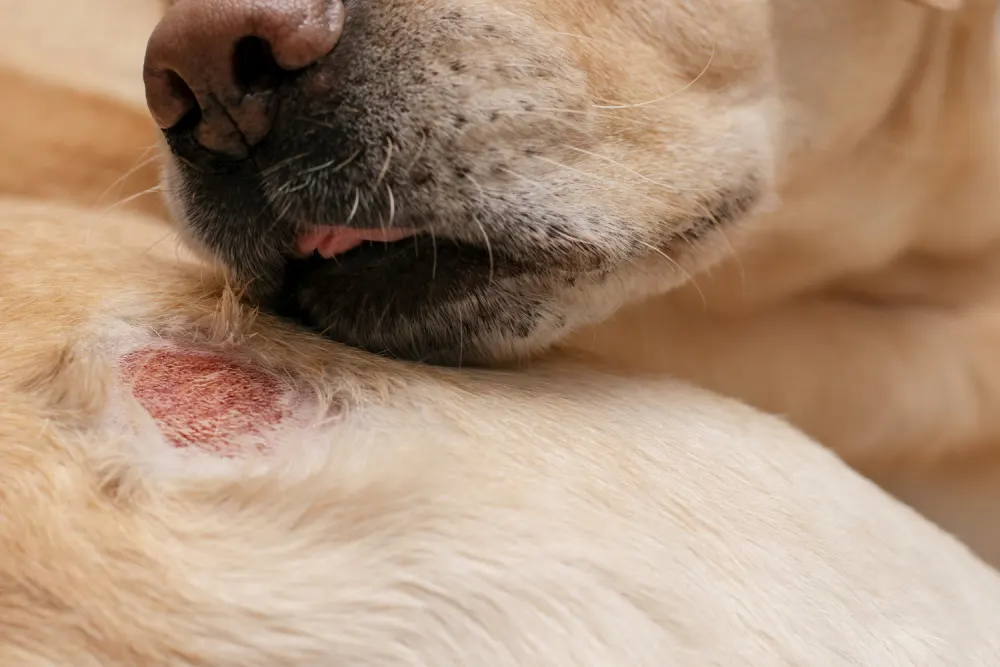
- Hair loss around the tumor site, particularly if the tumor is growing or inflamed
- Ulceration of the tumor surface, especially in trichoepitheliomas or infundibular types
- A discharge of keratin material, pus, or fluid from a central pore or broken skin surface
- Multiple small nodules in the same area or scattered across different parts of the body
- Redness or swelling around the base of the lump, indicating irritation or infection
Not every tumor will show all of these signs. Some will remain completely unchanged for months. But any new skin growth warrants attention.
Changes in Behaviour or Health
If a hair follicle tumor begins to grow, becomes inflamed, or ruptures, your dog may start showing behavioural signs of discomfort.
Watch for:
- Persistent licking, chewing, or scratching at a specific spot on the skin
- Rubbing the affected area against furniture, floors, or walls
- Sensitivity or flinching when the area is touched during grooming or petting
- Restlessness or changes in sleep if the tumor is in an uncomfortable position
- Signs of local infection such as heat, swelling, or a foul odour from the site
These behavioural changes are your dog’s way of communicating that something is not right. Do not dismiss them as quirks or anxiety. Check the skin carefully, and if you find a lump, take your dog to the vet.
Related Videos


Causes of Hair Follicle Tumors in Dogs
The honest answer is that the exact cause of most hair follicle tumors remains unknown. What veterinary medicine understands is the process, but not always the precise trigger.
Breed and Age Risk
Hair follicle tumors are more commonly diagnosed in middle-aged to older dogs, typically those between five and ten years of age. The cumulative effect of aging on skin cells is believed to contribute to the higher incidence in this group.
Certain breeds appear to have a genetic predisposition to developing these tumors. These include:
- Poodles
- Cocker Spaniels
- Basset Hounds
- English Springer Spaniels
- Wire Fox Terriers
- German Shepherds
- Bichon Frises
This does not mean dogs of other breeds are immune. Any dog can develop a hair follicle tumor. But if you own one of the breeds listed above, regular skin checks become even more important as your dog gets older.
Cellular Changes Within the Follicle
At the biological level, hair follicle tumors form when cells within the follicle structure begin dividing in an uncontrolled manner. The normal regulation that tells a cell when to grow and when to stop breaks down, and the resulting mass of cells forms a tumour.
What causes this regulatory failure is when the science becomes less definitive. Genetic mutations, hormonal changes, chronic irritation of the skin, or cumulative UV exposure may all play a role depending on the individual case. In most benign follicular tumors, no single identifiable cause is responsible.
What matters practically is this: because prevention is difficult, detection and early response are the most powerful tools available to any dog owner.
Diagnosing Hair Follicle Tumors in Dogs
You should never attempt to diagnose a skin lump on your dog at home. Many different skin conditions, including interdigital cysts on dogs, sebaceous cysts, mast cell tumors, and lipomas, can look or feel similar to follicular tumors. Only a veterinarian with the right tools can tell them apart.
Fine Needle Aspiration (FNA)
The first step in most skin lump evaluations is a fine needle aspiration. This is a minimally invasive procedure in which a thin needle is inserted into the lump to collect a small sample of cells.
The collected cells are placed on a glass slide and examined under a microscope. This process, called cytology, can often provide a preliminary indication of what the tumor is made of and whether malignant cells are present.
FNA is quick, inexpensive, and can usually be performed during a standard consultation with minimal stress to the dog.
Biopsy and Histopathology
For a definitive diagnosis, a biopsy is required. This involves removing a portion of the tumor, or in many cases the entire tumor, and sending it to a pathology laboratory for histopathological analysis.
Histopathology is the gold standard for diagnosing skin tumors. It tells the veterinarian not only what type of tumor it is but also whether the cells show features of malignancy, and whether the margins of the removed tissue are clean, meaning whether all the tumor cells appear to have been removed.
This information directly shapes the treatment plan.
Imaging Tests
In most cases of benign follicular tumors, imaging is not required. However, if the tumor is large, sits deep within the tissue, or if there is any clinical suspicion of malignancy, the veterinarian may recommend an ultrasound or X-ray.
Imaging helps evaluate whether the tumor has any involvement with deeper structures, lymph nodes, or surrounding tissue, and whether there is any evidence of spread elsewhere in the body.
Treatment for Hair Follicle Tumors in Dogs
The good news is that most hair follicle tumors are highly treatable. Because the majority are benign and do not spread, the options are relatively straightforward.
Surgical Excision
Surgical removal is the primary and most definitive treatment for most hair follicle tumors in dogs.
The procedure involves removing the tumor along with a margin of healthy surrounding tissue to reduce the chance of local recurrence. When the excision is complete and the margins are clean, the prognosis is excellent.
Recovery is typically smooth. Most dogs heal well within two to three weeks following surgery, and in the majority of cases, the tumor does not return at the same site.
It is worth noting that some dogs, particularly those with a genetic predisposition, may develop new follicular tumors at different locations over their lifetime. This is not a sign of spread from the original tumor. It reflects the underlying tendency of the dog’s skin cells toward this type of abnormal growth.
Monitoring Benign Tumors
Not every hair follicle tumor requires immediate surgical intervention.
If the tumor is confirmed as benign through FNA or biopsy, is small, is not causing any discomfort, and is not growing, the veterinarian may recommend a watchful waiting approach. This means scheduling regular follow-up appointments to measure and document any changes in the tumor’s size, shape, texture, or behaviour.
If the tumor remains stable and causes no problems, surgery may never be necessary. However, if it begins to grow, becomes inflamed, ruptures, or causes distress, removal at that stage is the appropriate course of action.
The decision to operate or monitor should always be made in consultation with your veterinarian based on the full clinical picture.
Related Products




Prognosis for Dogs with Hair Follicle Tumors
The prognosis for dogs with hair follicle tumors is generally very positive.
The vast majority of these tumors are benign, do not spread to other organs, and are cured with complete surgical removal. Dogs that undergo excision typically recover fully and go on to live healthy, comfortable lives.
The rare malignant variants, such as pilomatrix carcinoma or malignant trichoepithelioma, carry a more guarded prognosis. These tumors can recur locally after removal and, in some cases, may spread to regional lymph nodes or distant organs. If a malignant form is confirmed, your veterinarian may recommend additional treatment options or specialist referral.
Early detection, as with most canine tumors, significantly improves the outcome. A tumor identified and removed when it is small is almost always easier to treat than one that has been allowed to grow unchecked for months or years.
Monitoring Lumps and Skin Changes in Dogs
Every dog owner should make a habit of regularly checking their dog’s skin. This does not require veterinary training. It requires nothing more than your hands, good light, and ten minutes of focused attention during your regular grooming routine.
Run your hands over your dog’s entire body, including the head, neck, chest, legs, belly, and tail. Feel for any new lumps, bumps, thickened patches, or areas where hair is missing. Note anything that looks or feels different from the last time you checked.
Photographs can be useful. A simple photo taken on your phone, with a coin placed next to the lump for scale, gives you a reliable reference point to track whether the growth is changing over time.
Any lump that is new, growing, larger than a centimetre, causing your dog discomfort, or has been present for more than four weeks should be evaluated by a veterinarian without delay.
For additional guidance on identifying skin abnormalities, VOSD’s resource on dog medical conditions is a comprehensive reference for informed dog owners.
Can Hair Follicle Tumors Be Prevented?
Honestly, no. There is no proven method to prevent hair follicle tumors from developing in dogs.
Because the underlying cause in most cases involves genetic predisposition and natural changes in aging skin cells, there is no dietary supplement, topical treatment, or lifestyle modification with established evidence to stop them from forming.
What is within your control is early detection.
A dog whose owner checks for skin changes regularly and visits the vet promptly when something looks unusual is far more likely to have a tumor identified and treated at a stage where the outcome is simple, and the recovery is quick.
Prevention may not be possible. Early action always is.