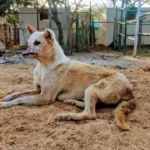
Underbite / Overbite in Dogs (Malocclusion): Causes, Symptoms & Care
Look at your dog’s mouth when they close it.
Do the teeth line up the way they should? Or does the lower jaw push out beyond the upper? Does the upper jaw extend so far forward that the lower teeth have nowhere to go?
If something looks off, it might be.
Malocclusion in dogs refers to the misalignment of the teeth or jaw. An underbite in dogs, an overbite in dogs, or other forms of bite misalignment can range from a minor quirk that causes no problems at all to a structural issue that affects chewing, causes mouth injuries, and impacts a dog’s comfort every single day.
Some dogs are born this way. Some develop it. And knowing what you’re dealing with makes all the difference.
What Is Malocclusion in Dogs?
Malocclusion simply means the upper and lower teeth don’t meet correctly when the mouth closes.
In a normal bite, called a scissor bite, the upper incisors sit just in front of the lower incisors, and the upper and lower teeth interlock cleanly. The jaw alignment allows comfortable chewing, natural wear across tooth surfaces, and no soft tissue contact with the teeth.
When that alignment is off, malocclusion in dogs occurs.
It can happen because of genetics; certain breeds are selectively bred for specific facial structures that naturally produce non-standard bites. It can happen due to abnormal jaw development during growth. It can happen when retained baby teeth force permanent teeth to erupt in the wrong position, disrupting the jaw’s natural alignment before it’s fully formed.
Mild malocclusion may cause no functional problems. Severe malocclusion can cause pain, difficulty eating, abnormal tooth wear, and repeated injury to the gum tissue or palate.
Underbite in Dogs
An underbite occurs when the lower jaw extends beyond the upper jaw, so the lower teeth sit in front of the upper teeth when the mouth is closed.
This is called a Class 3 malocclusion, or prognathism. And here’s something worth knowing: in certain breeds, it’s not considered a defect at all. Bulldogs, French Bulldogs, Boxers, Shih Tzus, Pugs, and Boston Terriers are among the breeds that are specifically bred for an undershot jaw. In these dogs, the underbite is a breed standard feature.
But that doesn’t automatically mean it’s problem-free.
An underbite in dogs becomes clinically significant when the lower canine teeth or incisors make contact with the upper gum tissue or palate when the mouth closes. That repeated pressure causes ulceration, pain, and chronic irritation. A dog with a severe underbite may be in low-grade discomfort every time they close their mouth, something they do thousands of times a day.
Mild underbites with no soft tissue contact may require nothing more than monitoring. Significant underbites that cause injury need veterinary intervention.
Overbite in Dogs
An overbite occurs when the upper jaw extends significantly beyond the lower jaw, leaving a gap between the upper and lower front teeth when the mouth closes.
This is called a Class 2 malocclusion, or brachygnathism. It’s less common than an underbite in dogs, but it can be equally problematic depending on severity.
In a significant overbite in dogs, the lower canine teeth, which should fit neatly between the upper canine and upper third incisor, have nowhere to go. They may dig into the hard palate, causing painful ulcers and wounds with every mouth closure. The lower incisors may press into the gum tissue behind the upper front teeth.
The structural problem is constant. Every time the dog closes its mouth, the same injury is repeated.
Mild overbites with normal tooth positioning and no soft tissue contact may be monitored without treatment. Moderate to severe overbites causing injury require professional management.
Related Videos

Symptoms and Problems Associated with Malocclusion
Malocclusion in dogs that is causing problems will show signs if you know what to look for.
Watch for these symptoms:
- Difficulty chewing, eating slowly, dropping food, chewing only on one side, avoiding hard food
- Mouth injuries and ulcers, wounds on the gum tissue, palate, or inner cheeks caused by teeth making abnormal contact
- Abnormal tooth wear, uneven, accelerated, or unusual wearing patterns on tooth surfaces due to incorrect occlusion
- Gum irritation or bleeding, chronic inflammation at sites of repeated tooth contact
- Excessive drooling, particularly if associated with oral pain or wounds
- Reduced appetite, eating becomes painful, so the dog eats less
- Bad breath, wounds, and chronic inflammation create bacterial activity
- Pawing at the mouth or face, a dog is communicating discomfort they can’t express otherwise
Malocclusion that causes none of these symptoms, that is, mild misalignment with no soft tissue contact, no abnormal wear, and no discomfort, may genuinely require nothing more than periodic monitoring. The goal is always function and comfort, not cosmetic perfection.
Treatment and Management Options
Treatment for malocclusion in dogs depends entirely on severity, the dog’s age, and whether the misalignment is causing functional problems.
Monitoring is appropriate for mild malocclusion with no pain, no soft tissue injury, and no functional impairment. Regular veterinary checks assess whether the situation is stable or progressing.
Removal of retained baby teeth is one of the most impactful early interventions. When a baby tooth is retained alongside the erupting adult tooth, it forces the permanent tooth into an abnormal position, and that abnormal position can set the jaw alignment for life. Early extraction of retained deciduous teeth, ideally during the teething phase, often at the time of desexing, can allow the jaw and teeth to develop more normally.
Dental adjustments, including crown reduction (reducing the height of a tooth to eliminate traumatic contact) or tooth extraction, are used in cases where specific teeth are causing soft tissue injury. The goal is to eliminate the source of pain, not to achieve a perfect bite.
Orthodontic devices, yes, they exist for dogs, are used in specific cases under specialist veterinary dental care. These are not cosmetic interventions. They are used when malocclusion is causing significant pain or functional impairment, and when the dog’s age and anatomy make them appropriate.
Pain management and wound treatment support comfort while longer-term solutions are implemented.
Malocclusion in dogs is not a condition to self-manage or treat at home. Assessment by a vet, and referral to a veterinary dental specialist for complex cases is the right path.

When to Consult a Veterinarian
Not every underbite or overbite needs urgent attention. But some do.
See a vet if your dog has:
- Visible wounds, ulcers, or bleeding inside the mouth
- Difficulty eating, chewing, or swallowing
- Any sign of pain when the mouth is touched or opened
- Retained baby teeth alongside erupting adult teeth. This needs prompt attention
- An underbite or overbite in a puppy that seems to be worsening as they grow
- Abnormal tooth wear was identified during a routine oral check
Even for mild malocclusion with no current symptoms, a baseline veterinary assessment is worthwhile. You need to know what you’re monitoring and what changes would indicate a problem developing.
For severe or complex cases, ask for a referral to a veterinary dental specialist. These are qualified professionals with specific expertise in bite assessment, orthodontic options, and surgical intervention. General practice vets handle the majority of malocclusion cases comfortably, but specialist input makes a real difference in complex situations.
Conclusion
Malocclusion in dogs, whether an underbite, overbite, or other bite misalignment, exists on a spectrum.
Mild cases may never cause your dog a moment of discomfort. Severe cases cause daily pain and need professional management.
The answer is always assessment first. Know what you’re dealing with. Monitor if it’s mild and stable. Act if it’s causing injury, pain, or functional problems.
A dog’s bite affects every meal, every chew, every moment the mouth closes. It deserves the same attention as every other aspect of their health.