VOSD National Field Manual – Institutional-Area Compliance Framework

A structured national framework explaining how Supreme Court institutional-area directions can be implemented lawfully, humanely, and with administrative accountability.

This unified edition has been developed to assist administrators, activists, courts, and coalitions in understanding the legal architecture, governance workflows, and ecological realities behind institutional-area implementation.

Rather than ideological positions, the manual focuses on defensible compliance models, integrating legal interpretation, waste governance, vaccination policy, and shelter engineering standards into one operational reference.

NatIonal FIeld Manual
VOSD National Field Manual outlining the Institutional-Area Compliance Framework for effective animal welfare and operational standards.
Share on Social Media

Download Now for Free

This document is issued in public interest as a structured compliance instrument to support lawful implementation and long-term governance stability.

*To maintain download integrity and ensure you receive future updates or revised editions, the whitepaper link will be sent to your email after form submission.

Why Structured Guidance Was Needed

Institutional-area implementation created a complex governance challenge: balancing public safety obligations with humane standards and existing statutory protections.

This manual was developed to:

  • Clarify the legal scope of institutional-area directions
  • Harmonise Supreme Court guidance with ABC Rules and PCA safeguards
  • Prevent administrative overreach and shelter collapse
  • Integrate waste ecology into population stabilisation
  • Provide workflows that are legally defensible and operationally realistic

The framework recognises that removal alone cannot solve urban animal governance; sustainable outcomes require ecosystem correction.

Inside the Field Manual

The whitepaper provides clause-level analysis, implementation workflows, and administrative models drawn from real governance scenarios.

Key areas covered include:

  • Legal architecture and scope interpretation
  • Institutional boundary doctrine and enforcement workflows
  • Shelter engineering and humane compliance models
  • Waste mapping and ecological carrying-capacity analysis
  • Rabies policy and vaccination strategy
  • Coalition governance and court-ready documentation frameworks

Each section is designed for real-world application, not theoretical debate.

Designed For Multiple Stakeholders

The unified edition includes audience-specific positioning to help different stakeholders engage with the issue through structured governance.

This document is relevant for:

  • District administrations and municipal authorities
  • Animal welfare organisations and coalitions
  • Policy researchers and legal practitioners
  • Public health and veterinary professionals
  • Institutional administrators navigating compliance requirements

Whether used in meetings, court submissions, or field oversight, the manual provides procedural clarity.
Other Publications

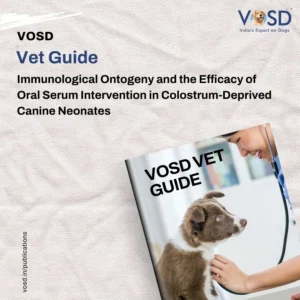
VOSD Vet Guide: Oral Serum Intervention in Colostrum-Deprived Puppies

This publication synthesizes molecular immunology, placental physiology, Fc receptor dynamics, and neonatal metabolic management into a comprehensive clinical reference.

Analysis of Urban Food Waste in India that Feeds Street Dogs

Analysis of Urban Food Waste in India that Feeds Street Dogs (2000–2005)

This publication compiles longitudinal data from 2000–2025 to evaluate how waste management systems influence stray dog populations and urban ecosystems.

VOSD Vet Practice

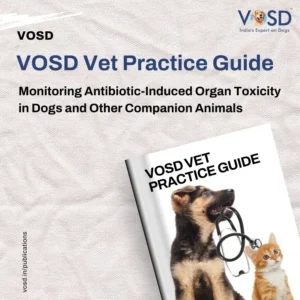
VOSD Vet Practice Guide: Monitoring Antibiotic-Induced Organ Toxicity

This guide reflects real clinical experience across veterinary hospitals, mobile clinics, and AI-enabled veterinary networks.

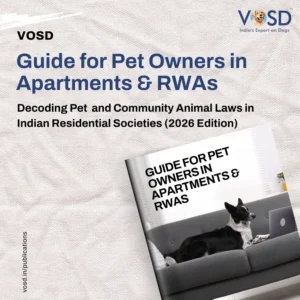
Guide for Pet Owners in Apartments & RWAs

The VOSD Comprehensive Guide for Pet Owners in Apartments & RWAs

It combines constitutional analysis, policy interpretation, and practical safeguards into one comprehensive resource for residential communities.