Infrastructure that Delivers the VOSD Level of Care
At VOSD, caring for a dog is not an idea alone. It is delivered through purpose-built infrastructure, trained personnel, codified systems, and a continuum of medical, rescue, rehabilitation, and lifetime care facilities designed around the real needs of dogs.
The VOSD Level of Care is VOSD’s philosophy and operating model for delivering lifecycle care to dogs, from first response and stabilisation, to surgery, inpatient treatment, rehabilitation, remote guidance, street support, and, where necessary, sanctuary-based lifetime care. This philosophy is made real through the VOSD infrastructure network.
For a pet owner seeking advanced care, a rescuer trying to save a dog in distress, a feeder supporting street dogs, or a referring veterinarian looking for escalation support, VOSD offers more than intent. It offers an integrated system.
Why Infrastructure Matters in Canine Care
Many dogs in India fail not because treatment is impossible, but because continuity is. They fall between street and shelter, between diagnosis and treatment, between surgery and recovery, and between intent and execution.
The VOSD infrastructure model is designed to address this gap.
When care is backed by structured infrastructure, dogs benefit from:
- Safer and more consistent handling
- Improved monitoring and treatment control
- Smoother escalation from simple to complex cases
- More reliable post-treatment recovery
- Reduced dependence on a single rescuer or caregiver
- The ability to support both short-term intervention and long-term care
- Clearer accountability across rescue, medical, and welfare systems
This is why the model is not built merely as a rescue organisation or a veterinary service, but as an integrated system for dogs whose needs do not fit into conventional categories.
The VOSD Infrastructure Network
1. VOSD IPD, Indiranagar
Inpatient and intensive clinical care in a structured treatment environment
VOSD IPD, Indiranagar is designed for dogs that require controlled, supervised, and medically managed care beyond routine outpatient treatment. It represents the disciplined inpatient layer of the VOSD care system.
Here, dogs are stabilised, monitored, and treated through active phases of illness and recovery within a structured clinical environment.
Role in the lifecycle of care:
- Stabilisation
- Inpatient treatment
- Short-stay medical management
- Structured recovery
- Escalation into advanced care pathways
2. VOSD Referral Hospital, Rural Bangalore
Advanced referral capability for complex and escalated canine cases
This facility serves as the advanced referral backbone for cases requiring deeper clinical judgment, infrastructure, and continuity. It handles over 200 critical lifecare treatments daily.
It supports difficult, unresolved, and medically intensive cases beyond standard clinic capacity.
Role in the lifecycle of care:
- Advanced referral
- Complex case management
- Escalated treatment
- Continuity for high-risk or unresolved cases
3. VOSD Sanctuary
Long-term residential care, rehabilitation, and lifetime refuge
VOSD Sanctuary is a purpose-built residential care institution for dogs requiring sustained, structured, and humane support, including disabled, geriatric, behavioural, and medically fragile cases.
It extends care beyond treatment into habitat design, cohort management, rehabilitation, and lifelong dignity.
Role in the lifecycle of care:
- Rehabilitation
- Protected recovery
- Special-needs management
- Behavioural segregation
- Geriatric care
- Lifetime sanctuary care
4. VOSD StreetCare
Distributed street-dog support through community and field systems
VOSD StreetCare supports dogs at the community level through feeding, early risk identification, and connection to escalation pathways.
It bridges the gap between street-level care and structured medical or rescue systems.
Role in the lifecycle of care:
- Street support
- Feeding continuity
- Early identification
- Community escalation
- Link to medical and rescue systems
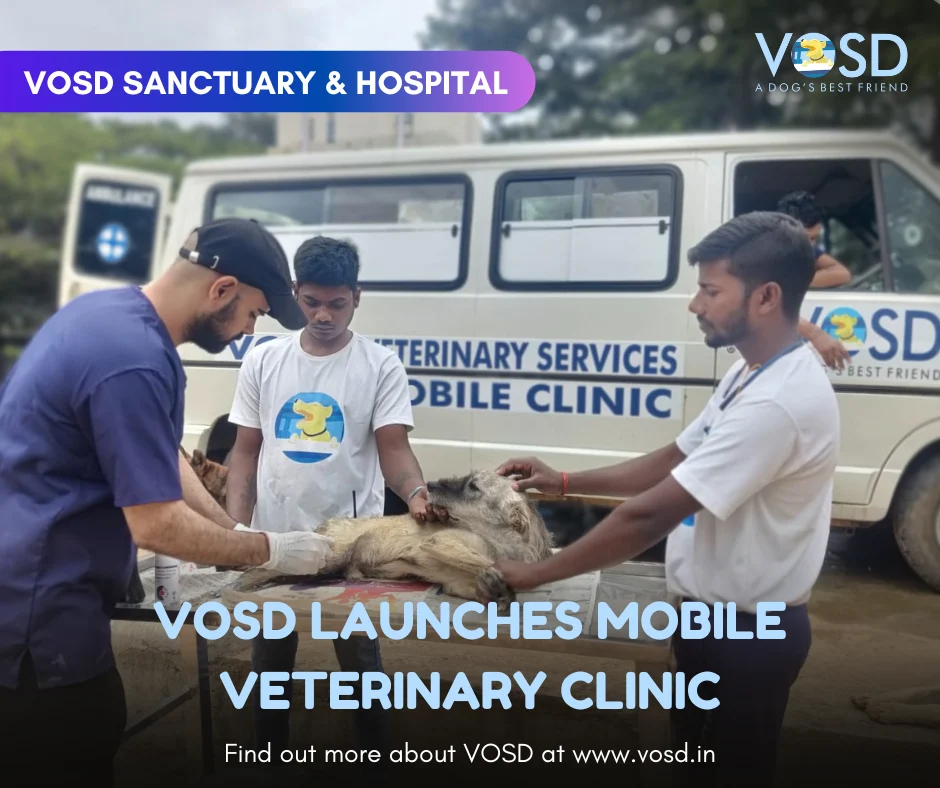
5. VOSD On-Wheels (Beta)
Mobile clinical infrastructure
Through Mobile OT-1 and mobile clinics, VOSD extends clinical care into the field, enabling treatment access where facility-based care is not immediately possible.
Role in the lifecycle of care:
- Field response
- Mobile clinical support
- On-site procedures
- Medical outreach
- Access extension
- Bridge to fixed facilities
6. VOSD CloudVet™ (Beta)
Remote intelligence and coordination layer
CloudVet™ is an AI-assisted system that connects cases, people, and facilities, supporting triage, guidance, and escalation decisions.
It enhances infrastructure by enabling early decision-making and coordinated response before physical intervention begins.
Role in the lifecycle of care:
- Remote triage
- Case guidance
- Coordination
- Escalation support
- Distributed access to expertise
Not Isolated Facilities. One Connected System.
What defines VOSD infrastructure is not just the presence of multiple facilities, but how they operate as one connected system.
A dog’s journey through care may look like this:
- Identified at the street level through community support systems
- Assessed remotely through coordinated triage
- Reached via mobile clinical infrastructure
- Stabilised in an inpatient care setting
- Escalated to advanced referral care if required
- Transitioned into long-term sanctuary care where necessary
Similarly, a pet dog may:
- Enter through structured clinical care
- Receive inpatient treatment
- Move into advanced referral care for complex conditions
- Continue with structured follow-up and monitoring
Many rescued dogs begin as emergency cases but require months or years of managed care. This is why the infrastructure exists, because real canine care is rarely linear or short-term.
Who This Infrastructure Serves
The system is designed to support multiple stakeholders facing a common reality: dogs require structured, continuous care, not one-time intervention.
This infrastructure supports:
- Pet owners seeking advanced and accountable care
- Rescuers managing urgent or high-risk cases
- Feeders and community caregivers supporting street dogs
- NGOs and welfare groups require escalation pathways
- Referring veterinarians handling complex cases
- Donors and supporters seeking impact backed by real capacity