Inpatient Care Environment
VOSD IPD provides a structured, admission-based environment for dogs requiring continued clinical supervision. This enables care to move beyond one-time consultation into managed treatment.
- Continuous observation within a clinical setting
- Adherence to treatment schedules
- Monitoring of response to therapy
- Faster response to changes in condition
- Recovery supported within a consistent system
Intensive Monitoring Logic
Not every admitted dog is critical, but each requires ongoing observation.
- Repeat clinical reviews
- Close monitoring of behaviour, appetite, pain, hydration, mobility, and responsiveness
- Timely adjustments to treatment plans
- Early identification of deterioration
- Safer recovery during vulnerable periods
This monitoring discipline is a core advantage of inpatient infrastructure.
Protocol-Led Treatment Delivery
Care is structured, not ad hoc, with emphasis on consistency and documentation.
- Treatment delivered according to scheduled plans
- Medication compliance in supervised settings
- Nursing and handling support
- Escalation to senior review when required
- Continuity in case documentation and decisions
Controlled Recovery Setting
A supervised environment reduces risks during recovery phases.
- Rest and recovery under observation
- Reduced variability in treatment delivery
- Monitoring of food, fluids, elimination, comfort, and pain
- Safe management of weak, post-operative, or vulnerable dogs
Bridge to Higher or Longer Care Pathways
VOSD IPD functions as a connected layer within the broader care system.
- From first presentation to stabilisation
- From OPD assessment to admission
- From rescue intake to deeper diagnostics
- From admission to referral escalation
- From advanced care back into monitored recovery
- From treatment into rehabilitation or sanctuary care
This integration is central to the VOSD Level of Care.
Not Just Inpatient Care. A System of Clinical Continuity.
What distinguishes VOSD IPD, Indiranagar, is that it functions as part of a larger, connected care architecture.
A dog admitted here is not simply occupying a bed; it is within a system that connects to:
- VOSD Advance PetCare™ for structured clinical access
- VOSD Referral Hospital, Rural Bangalore, for the escalation of complex cases
- VOSD CloudVet™ for distributed case support and continuity
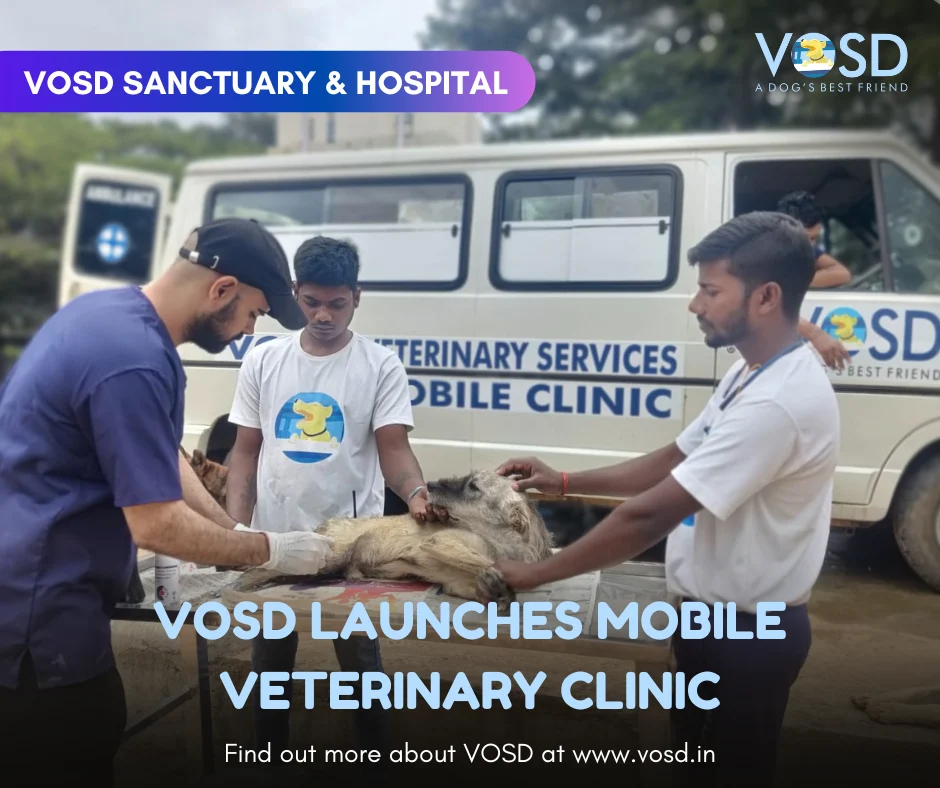
- VOSD On-Wheels for mobility and field-linked transfer
- VOSD Sanctuary for long-duration or non-dischargeable cases
The facility is not an endpoint. It is one layer in a complete care journey.
What Pet Owners Can Expect
For pet owners, VOSD IPD provides reassurance when routine care is not enough.
- Supervised treatment instead of fragmented home care
- Closer monitoring during critical periods
- Continuity between diagnosis, treatment, and recovery
- Clear escalation pathways if conditions worsen
- Integration with broader care systems when needed
This becomes especially relevant when the concern shifts from “what medicine to give” to “where proper care and monitoring can happen.”
What Rescuers Can Expect
For rescuers, the challenge is often not diagnosis but sustained treatment support.
- Supervised treatment capacity
- Structured medical follow-through
- Observation for fragile or unstable dogs
- Continuity for multi-step interventions
- Linkage to referral or long-term care systems
VOSD IPD exists to ensure that care does not fail due to lack of structured follow-through.
How VOSD IPD Fits into the Dog’s Lifecycle of Care
The facility supports multiple stages of need:
- Early Instability: When a dog cannot be safely managed at home or on the street
- Active Treatment: When repeated medication, nursing, and supervision are required
- Post-Operative Recovery: When controlled recovery is necessary before discharge
- Clinical Uncertainty: When time and repeated evaluation are needed
- Escalation: When stabilisation is required before referral to care
- Step-Down Recovery: When monitored care is needed after a major intervention
VOSD IPD is best understood as an infrastructure function within a larger system, not just a physical ward.
Why This Infrastructure Improves Outcomes
Better outcomes often depend on disciplined, continuous care:
- Observing a dog over time
- Identifying deterioration early
- Ensuring timely treatment delivery
- Adjusting care based on response
- Supporting recovery, not just diagnosis
- Having escalation pathways when needed
VOSD IPD is built around these principles through:
- Control
- Continuity
- Discipline
- Observation
- Integration
- Escalation readiness
This is how infrastructure improves medicine, and how medicine improves survival, comfort, and recovery.
The VOSD Difference
At VOSD, infrastructure is built on accountability. The IPD reflects a broader belief: dogs deserve not only compassion, but systems capable of supporting them through difficult phases of care.
This belief means:
- Care does not end after consultation
- Treatment is not left to improvisation
- Recovery is actively supported
- Escalation happens before the crisis deepens
- Every dog has access to deeper care when needed
VOSD IPD is where that promise becomes real.