

If your dog’s eye looks pushed out, do not wait.
Bulging eyes in dogs are not a condition to observe overnight, research the next morning, or bring up at a routine appointment next week. They are a symptom that demands immediate veterinary attention, because the underlying causes range from serious to catastrophic, and the window between a treatable situation and permanent vision loss can be measured in hours rather than days.
A bulging eye is not a disease in itself. It is a visible sign that something has gone significantly wrong with the eye, the structures behind it, or the pressure within it. Understanding what that sign means, what is causing it, and what needs to happen next is information every dog owner should have before they are ever in the position of needing it.
What Are Bulging Eyes in Dogs?
Bulging eyes refer to an abnormal forward protrusion of one or both eyes beyond their normal position within the eye socket. The eye appears pushed outward, larger than usual, or displaced from its correct anatomical position. This protrusion can range from a subtle forward displacement that an attentive owner notices as a change from the dog’s normal appearance, to a severe, visible displacement of the eye that constitutes one of the most alarming sights in veterinary emergency medicine.
There are three distinct clinical presentations of bulging eyes in dogs, each with different causes and different implications.
Proptosis is the most severe form. It occurs when the eyeball is physically displaced forward and partially or fully out of the eye socket. This is a traumatic emergency. The eye is exposed, the muscles and tissues holding it in place are stretched or torn, and the optic nerve is under acute stress. Proptosis requires emergency veterinary intervention within hours to have any realistic chance of saving the eye or the dog’s vision.
Exophthalmos refers to abnormal forward protrusion of the eye that remains within the socket but is pushed forward by a space-occupying process behind it. A mass, abscess, or accumulation of fluid or blood in the orbital space behind the eye pushes the eye forward from within. The eye itself may be structurally intact, but its position is abnormal, and its function is under threat.
Buphthalmos is an enlargement of the eyeball itself rather than a displacement of a normal-sized eye. It occurs when elevated intraocular pressure, typically from glaucoma, causes the eye to physically expand over time. The eye appears larger than normal and may have a distinctive hardened quality when gently assessed. Buphthalmos indicates that elevated pressure has been present long enough to stretch the eye’s structural layers.
Recognising which type of bulging is present helps direct the urgency and nature of the veterinary response, but all three presentations require professional assessment without delay.
Symptoms of Bulging Eyes in Dogs
The visible protrusion or enlargement of the eye is the defining sign, but it is rarely the only one. Dogs with bulging eyes typically show a constellation of additional symptoms that reflect the discomfort, structural compromise, and functional impact of whatever is causing the eye to protrude.
Forward protrusion or displacement of the eye is the primary and defining observation. The eye may appear larger, more prominent, or visibly displaced from its normal position within the socket.
Redness and inflammation of the conjunctiva and the visible surfaces around the eye are almost universally present. The degree of redness reflects the level of inflammation and vascular congestion in the tissues around and behind the eye.
Pain and squinting are present in most cases, reflecting the pressure, stretching, and tissue stress that accompany abnormal eye protrusion. A dog in pain around the eye will often hold it partially closed, resist handling near the face, or show generalised signs of distress.
Discharge ranging from watery to mucopurulent may accumulate around the protruding eye as the normal eyelid mechanics are disrupted and the eye surface is no longer adequately protected or lubricated.
Inability to blink normally is a particularly serious sign. The eyelids depend on the eye being in its correct position to close completely over it. When the eye is protruding significantly, the eyelids may no longer reach across the exposed surface, leaving the cornea unprotected and vulnerable to rapid desiccation and damage.
Vision changes or apparent vision loss may be present depending on the severity of the protrusion and the degree to which the optic nerve and retinal circulation are compromised.
Causes of Bulging Eyes in Dogs
Trauma
Trauma is the most common cause of proptosis, the most severe form of eye protrusion. A dog struck by a vehicle, involved in a fight with another dog, or subjected to any significant blunt force trauma to the head can sustain proptosis as a result. In brachycephalic breeds with shallow eye sockets, even relatively minor trauma can be sufficient to displace the eye. The physical force compresses the orbital contents and, when combined with the shallow socket that offers less structural containment, forces the eye forward and out of its normal position.
Glaucoma
Glaucoma, a condition characterised by elevated intraocular pressure, is the primary cause of buphthalmos. When the pressure inside the eye rises above normal levels and remains elevated over time, the structural layers of the eye begin to stretch. The sclera, which forms the white outer coat of the eye, gradually expands under the sustained pressure, producing an eye that is visibly larger than normal. Glaucoma causes significant pain and progressive damage to the optic nerve and retina, ultimately leading to blindness if not managed. The enlarged, hardened appearance of a buphthalmic eye is a sign that elevated pressure has already been present for a significant period.
Orbital Infections and Abscesses
Infections developing in the space behind the eye, called the orbit, produce exophthalmos by creating a mass of inflammatory tissue or pus that pushes the eye forward. Orbital abscesses often develop secondary to dental infections in the upper jaw, where the roots of the upper carnassial teeth lie very close to the orbital floor. A dog with an orbital abscess typically presents with unilateral eye protrusion, pain on opening the mouth, and often a visible swelling behind the last upper molar. These cases require prompt treatment to drain the infection and eliminate its source.
Understanding the full range of diseases of the orbit of the eye in dogs provides important clinical context for understanding how the space behind the eye can be affected by multiple different processes, all of which share the common final pathway of pushing the eye forward.
Tumours Behind the Eye
Space-occupying masses in the orbit, including primary tumours of the orbital tissues and secondary tumours that have spread from adjacent structures, cause progressive exophthalmos as they grow. Unlike traumatic proptosis, which is acute and dramatic, tumour-associated exophthalmos often develops gradually over weeks to months. The progressive nature means it may initially be subtle enough to be missed until the protrusion becomes clearly visible.
Bleeding or Severe Inflammation Behind the Eye
Haemorrhage behind the eye, occurring secondary to trauma, bleeding disorders, or vascular abnormalities, can rapidly increase the volume of contents within the orbital space and push the eye forward. Severe orbital inflammation, whether infectious or immune-mediated in origin, can have the same effect.
Related Videos

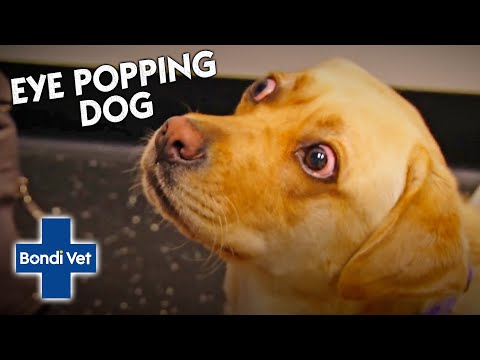


Emergency Causes: Proptosis
Proptosis deserves specific emphasis because it is the most immediately life-threatening presentation of bulging eyes and the one that most commonly requires owners to act within minutes rather than hours.
When a dog’s eye is displaced out of its socket following trauma, the optic nerve is stretched. The blood supply to the retina is compromised. The cornea, now fully exposed and unable to be covered by the eyelids, begins to dry out immediately. Every minute without intervention is a minute in which irreversible damage to the optic nerve and retinal tissue is accumulating.
The eye must be kept moist during transport to the veterinary clinic. A clean, damp cloth placed gently over the eye, without any pressure that might push the eye further, helps protect the corneal surface. Do not attempt to push the eye back into the socket. Do not apply any drops or substances to the eye without veterinary instruction. Go directly to the nearest veterinary emergency facility.
The chance of saving the eye and preserving vision following proptosis depends on how quickly the eye is repositioned, how much damage was done to the optic nerve and surrounding structures at the time of injury, and the breed of the dog. Brachycephalic breeds with shallow sockets have a better prognosis for eye retention after proptosis than deep-socketed breeds, where greater force is required to displace the eye and the resulting damage to surrounding structures is typically more extensive.
Breed Predisposition
Brachycephalic breeds, those with the characteristic shortened, flattened facial structure, carry a significantly elevated risk for eye protrusion compared to dogs with normal facial anatomy. Breeds including the Pug, Shih Tzu, Pekingese, French Bulldog, English Bulldog, and Boston Terrier have naturally shallow eye sockets that provide less structural containment and protection for the eyeball.
In these breeds, the eye protrudes more prominently even under normal conditions, which is part of the characteristic appearance of the breed. This natural prominence means the margin between normal position and dangerous protrusion is much smaller. Minor trauma, physical restraint, tight collars, or even vigorous play can be sufficient to produce proptosis in a brachycephalic dog that would cause no ocular injury at all in a dog with a deeper orbital structure.
Owners of brachycephalic breeds should be aware of this elevated risk and should avoid situations that create direct pressure around the neck and head, use harnesses rather than neck collars, and seek veterinary assessment for any change in eye prominence that appears to develop suddenly or is associated with any form of head trauma.
The structural vulnerabilities of brachycephalic breeds also extend to other developmental eye concerns, and the broader context of eye defects (congenital) in dogs is a relevant background for owners of breeds already predisposed to ocular complications.
Diagnosis of Bulging Eyes in Dogs
Diagnosis of bulging eyes begins with the clinical presentation itself, but identifying the underlying cause requires targeted investigation to determine whether the protrusion is due to elevated intraocular pressure, an orbital mass, infection, or traumatic displacement.
Physical examination includes assessment of the degree and direction of protrusion, the condition of the corneal surface, the responsiveness of the pupil to light, and the dog’s pain response to gentle manipulation around the eye and jaw.
Tonometry to measure intraocular pressure is essential in any dog presenting with eye enlargement or protrusion, as distinguishing glaucoma-related buphthalmos from other causes of apparent eye bulging directly determines the treatment approach. Elevated pressure requires a specific pressure-lowering intervention that is different from the management of orbital infection or trauma.
Imaging, including skull radiography, ultrasound of the orbit, and CT or MRI scanning where available, is used to identify space-occupying masses, abscesses, orbital fractures, or haemorrhage behind the eye. In cases of suspected orbital abscess, the relationship between the molar tooth roots and the orbital floor is specifically assessed.
Fluorescein staining of the cornea identifies ulceration, which develops rapidly in eyes that are protruding and cannot be covered by the eyelids, and determines the degree of corneal damage already present at the time of presentation.
Treatment of Bulging Eyes in Dogs
Infections and Orbital Abscesses
Orbital infections and abscesses are treated with systemic antibiotics to eliminate the bacterial infection, and in most cases, drainage of the abscess is required to remove the source of pressure and allow the infection to resolve. Where the infection originates from a diseased tooth root, extraction of the affected tooth is part of the definitive treatment. With prompt and appropriate management, exophthalmos associated with orbital infection typically resolves as the infection clears and the orbital swelling subsides.
Glaucoma
Glaucoma management focuses on reducing intraocular pressure to protect the optic nerve and retina from further damage. Medical treatment with topical and systemic pressure-lowering medications is initiated immediately in acute presentations. Surgical options to improve aqueous humour drainage may be considered in cases where medical management alone is insufficient to control pressure. In dogs where the eye has already become blind and painful due to chronic, uncontrolled glaucoma, surgical removal of the eye may be the most appropriate option to eliminate ongoing pain.
Trauma and Proptosis
Surgical replacement of a proptosed eye, performed under general anaesthesia, involves carefully repositioning the eye within the socket and temporarily suturing the eyelids partially closed to prevent re-protrusion during the initial healing period. The success of this procedure in preserving vision depends on the speed of intervention and the extent of damage to the optic nerve and vascular supply at the time of injury. In cases where the eye cannot be saved, surgical removal eliminates pain and allows healing to proceed.
Tumours
Orbital tumours require advanced investigation to characterise the type of mass and determine whether surgical excision, radiotherapy, or palliative management is appropriate. The prognosis depends on the nature of the tumour, its extent, and whether it has spread beyond the orbital space.
Related Products

Prognosis and Recovery
The prognosis for dogs with bulging eyes depends entirely on the underlying cause and how quickly treatment is initiated.
Dogs with orbital abscesses treated promptly generally recover well, with the exophthalmos resolving as the infection clears. Dogs with glaucoma-associated buphthalmos that is identified and managed before significant optic nerve damage has occurred can retain functional vision with appropriate ongoing treatment.
Dogs with traumatic proptosis have a prognosis that varies significantly based on breed and the severity of the injury. The optic nerve’s integrity at the time of injury is the most important prognostic factor for vision preservation after surgical repositioning. Some dogs retain useful vision following successful repositioning. Others, particularly those in deep-socketed breeds where the force required to produce proptosis inevitably causes extensive damage, may retain an eye that is structurally present but functionally blind.
Understanding what blindness in dogs means in terms of a dog’s daily life, its ability to adapt, and the practical management adjustments that support a blind dog’s quality of life is important background for owners facing the possibility that vision may not be fully restored.
In all cases, speed of treatment is the single most controllable variable. The outcomes associated with prompt intervention are consistently better than those associated with delayed care.
Complications If Left Untreated
Bulging eyes that are not treated promptly and appropriately lead to a predictable sequence of worsening complications.
Corneal desiccation and ulceration develop rapidly in protruding eyes that cannot be adequately covered by the eyelids. The corneal surface dries, loses its structural integrity, and ulcerates. Deep corneal ulcers can progress to perforation of the eye.
Permanent vision loss results from sustained elevated intraocular pressure causing optic nerve death, from prolonged stretching of the optic nerve in untreated proptosis, or from retinal damage secondary to compromised blood supply. Vision lost through these mechanisms cannot be restored.
Chronic pain from uncontrolled glaucoma, untreated corneal ulceration, or an eye that has lost its structural integrity becomes the dog’s daily reality when bulging eyes are left without appropriate management. This is entirely preventable with timely care.
Loss of the eye is the outcome of severe, untreated, or unsuccessfully managed bulging eye conditions, particularly in traumatic proptosis and end-stage glaucoma. Surgical removal of a permanently damaged and painful eye, while not the outcome anyone hopes for, eliminates suffering and is always preferable to leaving a dog in chronic ocular pain.
What to Do Immediately
If you observe that your dog’s eye is bulging, protruding, or appears to have shifted from its normal position, the following steps apply before you reach veterinary care.
Do not touch or apply pressure to the eye. Any pressure on an already protruding eye risks additional displacement and further damage to the supporting structures.
If the eye is visibly exposed and cannot be covered by the eyelids, place a clean, damp cloth very gently over the eye area without pressure. This helps prevent the corneal surface from drying out during transport.
Do not attempt to push the eye back into the socket. This is not a home procedure, and attempting it risks catastrophic damage.
Do not apply any eye drops, ointments, or other substances without specific instruction from a veterinarian.
Go directly to the nearest veterinary emergency facility. Call ahead if possible so the team is prepared to receive an ocular emergency on your arrival.
Time is the factor you can control. Everything else depends on the veterinarian. Your job is to get there as safely as possible.
When to See a Vet
Any dog showing the following signs should be treated as a veterinary emergency without exception.
- Any visible forward protrusion or displacement of one or both eyes
- One eye appearing significantly larger than the other
- An eye that looks pushed out following any form of head trauma
- Inability of the eyelids to close fully over the eye surface
- Sudden onset of eye redness, severe squinting, and apparent pain
- Any change in eye prominence in a brachycephalic breed following play, restraint, or minor trauma
There is no presentation of bulging eyes in a dog that is safe to monitor at home and reassess the next day. All forms of eye protrusion represent either an active emergency or an urgent situation requiring same-day veterinary assessment. Acting immediately is not an overreaction. It is the only appropriate response.















