
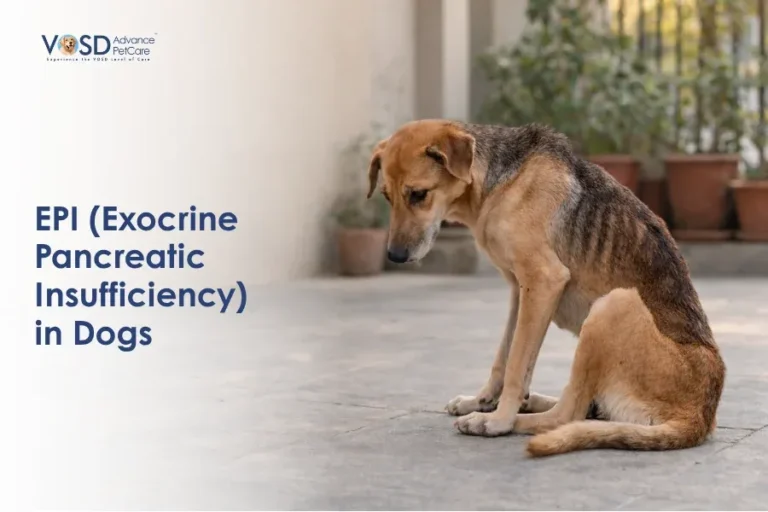
The dog is eating. But starving.
This is the paradox that defines EPI, and it is also the reason it goes undiagnosed for so long. A dog that is consuming food with apparent enthusiasm, sometimes more food than ever before, does not look like a dog with a serious nutritional crisis. But when the pancreas cannot produce the digestive enzymes needed to break down that food, the meal passes through the gastrointestinal tract largely undigested, providing almost no nutritional benefit.
The body begins drawing on its own reserves. Muscle is lost. Weight drops. The coat deteriorates. The dog becomes increasingly hungry because it is, in the most literal sense, not being fed by the food it is eating.
EPI is not a feeding problem. It is a digestion failure, and it requires a very different response.
What Is EPI in Dogs?
Exocrine pancreatic insufficiency is a condition in which the pancreas fails to produce adequate quantities of the digestive enzymes required for normal digestion. The exocrine pancreas, the portion of the gland responsible for enzyme production, generates lipase, protease, and amylase, the enzymes that break down fats, proteins, and carbohydrates, respectively. When production of these enzymes falls below the threshold needed for effective digestion, food is not broken down into absorbable nutrients.
Instead of being digested and absorbed in the small intestine, the food passes through largely intact, feeding the bacterial populations of the gut rather than the dog. The consequence is a combination of malnutrition, intestinal bacterial overgrowth, and the characteristic stool changes that reflect undigested fat and starch reaching the large intestine.
Why This Condition Is Serious
The severity of EPI extends well beyond loose stools and a thin body condition. Dogs with untreated or undertreated EPI are in a state of progressive malnutrition that depletes muscle mass, impairs immune function, and produces specific vitamin deficiencies that compound the primary digestive failure.
Cobalamin (vitamin B12) deficiency is near-universal in dogs with EPI. Cobalamin is absorbed in the ileum and is dependent on a healthy intestinal environment. The bacterial overgrowth associated with EPI impairs cobalamin absorption, and deficiency produces neurological, immunological, and gastrointestinal complications that can persist even after enzyme replacement is initiated.
Dogs with severe or longstanding EPI can reach a state of nutritional compromise that makes recovery more protracted and the management protocol more complex. A dog that has been losing weight for months on a background of undiagnosed EPI carries a higher deficit to overcome than one diagnosed and treated early.
Symptoms of EPI in Dogs
- Significant weight loss despite a normal or increased appetite
- Chronic diarrhoea producing loose, pale, greasy, or voluminous stools
- Excessive hunger (polyphagia) that persists despite apparently normal food intake
- Excessive flatulence from bacterial fermentation of undigested food in the colon
- Progressively poor coat quality, with a dull, dry, or rough appearance
- Coprophagia, eating faeces, which may reflect the dog’s attempt to access undigested nutrients
- Generalised weakness and reduced activity as nutritional depletion progresses
The combination of weight loss and increased appetite in the same dog is the clinical signal that should immediately raise suspicion for EPI. These two signs are in apparent contradiction if food intake is the focus, but they are entirely consistent when digestion failure is understood as the mechanism.
Related Videos


Causes of EPI in Dogs
Primary Causes
Pancreatic acinar atrophy is the most common cause of EPI in dogs and the primary mechanism in the majority of cases diagnosed in young to middle-aged dogs, particularly German Shepherds and Rough Collies. In this condition, the enzyme-producing acinar cells of the exocrine pancreas progressively atrophy and are replaced by non-functional tissue, reducing enzyme output below the threshold required for adequate digestion.
The cause of pancreatic acinar atrophy is believed to involve an immune-mediated component in genetically predisposed individuals, though the exact mechanism has not been fully characterised. The condition appears to be heritable in German Shepherds, which are dramatically overrepresented in EPI diagnoses.
Autoimmune destruction of the pancreatic acinar tissue is a less common but recognised primary cause, where the immune system directly targets and destroys the enzyme-producing cells.
Secondary Causes
Chronic pancreatitis is the most significant secondary cause of EPI. Repeated or sustained pancreatic inflammation progressively destroys the acinar cells over time, eventually reducing enzyme production to insufficient levels. This pathway explains the occurrence of EPI in breeds and age groups not typically associated with primary acinar atrophy.
Pancreatic obstruction from neoplasia, trauma, or other structural causes can also impair enzyme delivery to the intestine, producing EPI as a consequence of the primary structural disease.
How Veterinarians Diagnose EPI in Dogs
The diagnostic approach to EPI is straightforward when the condition is considered, which is exactly why the most important step is raising clinical suspicion in a dog with the characteristic presentation.
The serum trypsin-like immunoreactivity test, known as the TLI test, is the gold standard for diagnosis. It measures the blood level of trypsinogen, a pancreatic enzyme precursor. In dogs with EPI, TLI levels are markedly reduced, and a result below the reference range confirms the diagnosis with high specificity.
Cobalamin levels should be measured at diagnosis in every EPI patient, as deficiency is common, significantly affects treatment response, and requires specific supplementation.
Faecal evaluation can provide supportive evidence of maldigestion, including the presence of undigested fat and starch in the stool, though it is not diagnostic on its own.
| Stage | What Is Observed | Action Required |
|---|---|---|
| Early | Weight loss despite normal or increased appetite | Veterinary consultation and TLI testing |
| Moderate | Chronic diarrhoea, poor coat, progressive weight loss | Blood tests confirming low TLI, cobalamin measurement |
| Confirmed | Low enzyme levels on TLI test | Begin pancreatic enzyme replacement therapy |
| Managed | Weight gain, stool normalisation, improved coat | Long-term enzyme therapy, cobalamin supplementation, monitoring |
Treatment for EPI in Dogs
Treatment for EPI is effective and produces rapid, visible improvement in most dogs. It is also lifelong. EPI is managed, not cured, and the underlying pancreatic insufficiency does not recover in the majority of cases.
Pancreatic Enzyme Replacement Therapy (Primary Treatment)
Pancreatic enzyme replacement therapy is the cornerstone of EPI management. Powdered porcine pancreatic extract containing lipase, protease, and amylase is mixed into the dog’s food immediately before each meal. The supplemented enzymes perform the digestive function that the dog’s own pancreas cannot provide.
The response to enzyme replacement in most dogs is dramatic. Weight gain, stool normalisation, and reduction of polyphagia typically occur within one to two weeks of initiating treatment. The dose is adjusted based on clinical response, body weight change, and stool quality.
Raw pancreas from porcine sources can be used as an alternative to powdered extract in some cases and is often effective, though sourcing, storage, and parasite risk require consideration.
Vitamin B12 Supplementation
Cobalamin deficiency in dogs with EPI requires direct supplementation, as dietary cobalamin cannot be reliably absorbed through an intestinal environment compromised by bacterial overgrowth. Parenteral cobalamin injections are the most reliable route of supplementation and are given at regular intervals initially, then at maintenance frequency based on blood level monitoring.
Failure to address cobalamin deficiency is one of the most common reasons for a suboptimal response to enzyme replacement therapy.
Antibiotics (If Gut Imbalance Is Present)
Small intestinal bacterial overgrowth occurs secondary to EPI in many dogs. When present, a short course of appropriate antibiotics reduces the bacterial population to more normal levels, improving the intestinal environment and cobalamin absorption. This intervention is particularly relevant in dogs whose response to enzyme replacement is less complete than expected.
Dietary Management
A highly digestible, moderate-fat diet supports the digestive capacity available with enzyme supplementation. High-fat diets challenge lipase availability beyond what supplementation can reliably support. High-fibre diets have been shown in some cases to reduce the efficacy of enzyme supplements. A consistent, appropriate diet combined with enzyme supplementation at each meal forms the practical daily management protocol.
Related Products
Prognosis
The prognosis for EPI with appropriate treatment is generally good. Most dogs show rapid and meaningful clinical improvement within the first weeks of enzyme replacement therapy and go on to maintain a healthy body weight and good quality of life.
The realistic expectation is that treatment is lifelong. In the majority of cases, the underlying pancreatic atrophy or damage is not reversible, and discontinuing enzyme supplementation results in immediate return of maldigestion and weight loss.
Dogs that are diagnosed and treated before severe nutritional depletion has occurred recover most completely. Dogs with longstanding, severe EPI at the time of diagnosis require more prolonged management to rebuild body condition, and concurrent cobalamin deficiency must be addressed for full clinical response to be achieved.
Complications of EPI in Dogs
Cobalamin deficiency is the most clinically significant complication and occurs in the majority of affected dogs. Beyond its effects on the gastrointestinal tract, cobalamin deficiency impairs neurological function, immune response, and cellular metabolism. Supplementation must be initiated alongside enzyme therapy rather than treated as a secondary concern.
Small intestinal bacterial overgrowth compounds malabsorption, impairs nutrient uptake, and reduces the effectiveness of both enzyme supplementation and dietary management. It requires specific antibiotic intervention in affected dogs.
Secondary intestinal disease, including villous atrophy from chronic maldigestion, can develop in dogs with longstanding untreated EPI and may produce a more complex recovery even after enzyme supplementation is initiated.
Why EPI Is Often Misdiagnosed
EPI is consistently underdiagnosed and delayed in diagnosis because its symptoms are easily attributed to other, more commonly considered conditions.
A dog with loose stools and weight loss is often treated empirically for intestinal parasites before EPI is considered. A dog with increased appetite and poor coat is sometimes attributed to an inadequate diet or feeding error rather than a digestive failure. A dog with flatulence and coprophagia may be managed as a behavioural problem rather than investigated for the nutritional deficiency that is driving both behaviours.
The key differentiating feature is the combination of weight loss and increased appetite in the same dog. This pattern does not fit the clinical picture of simple diarrhoea or dietary inadequacy. It demands investigation for EPI.
When to See a Veterinarian
Contact your veterinarian promptly if your dog shows any of the following:
- Progressive weight loss despite normal or increased food intake
- Chronic loose, pale, greasy, or voluminous stools
- Persistent excessive hunger that does not resolve with normal feeding
- Progressively deteriorating coat quality
- Coprophagia that has developed as a new behaviour
- Any combination of these signs in a German Shepherd or other predisposed breed
Do not manage these signs with dietary changes alone or treat empirically for parasites without a diagnostic workup. The longer EPI goes undiagnosed, the greater the nutritional deficit that must be overcome, and the more complex the recovery.
Prevention and Management
EPI in its primary form, particularly pancreatic acinar atrophy in predisposed breeds, cannot be reliably prevented as it reflects an underlying genetic and immune-mediated process. For German Shepherds and other predisposed breeds, awareness of the condition and a low threshold for investigation when characteristic signs appear provides the best opportunity for early diagnosis.
Secondary EPI arising from chronic pancreatitis can be partially prevented through management of the factors that drive recurrent pancreatic inflammation, including dietary fat restriction, weight management, and control of underlying metabolic disease.
Regular veterinary health checks allow early detection of weight loss and digestive changes before the nutritional deficit becomes severe. Annual body weight and condition assessment provides a baseline against which progressive changes can be identified early.