You are watching your Doberman stand in the kitchen, and something catches your eye.
One hind leg lifts. Then the other. Back and forth, rhythmically, like they are stepping in place to music only they can hear. They are not scratching. They are not trying to sit. They are just standing there, legs alternating in a slow, involuntary rhythm.
It looks almost amusing the first time. By the third or fourth time, it looks like something is wrong.
It is. What you are watching is Dancing Doberman Disease, a neurological movement disorder that is far more significant than it appears, and one that most owners do not recognize until it has been progressing for months.
What This Condition Really Is: A Movement Disorder, Not Just Muscle Twitching
Dancing Doberman Disease is not a muscle cramp. It is not pain behavior. It is not a quirky habit.
It is a neurological movement disorder characterized by involuntary, alternating lifting of the hind limbs while the dog is standing. The dog flexes one hind leg at the stifle, holds it briefly, lowers it, then lifts the other. The cycle repeats continuously, for as long as the dog remains standing.
The medical term for this condition is canine distal polyneuropathy, and it is classified as a movement disorder originating from abnormal nerve signaling rather than from the muscles themselves.
In the early stages, the dog typically shows no signs of pain. They eat normally, walk reasonably well, and seem otherwise fine. The dancing is the only sign. That is precisely why it gets dismissed for so long.
A Visual Breakdown of the “Dancing” Movement Pattern
Understanding exactly what the movement looks like helps owners identify it accurately.
- The dog is standing still, not walking or trotting
- One hind limb lifts from the stifle joint downward, flexing upward
- The leg is held in a partially raised position for one to several seconds
- It is lowered, and the opposite hind limb lifts in the same way
- The alternation continues rhythmically as long as the dog stands
- The front limbs remain planted and unaffected
- The movement is not triggered by pain, touch, or external stimulation
- The dog appears unaware or minimally bothered by it in early stages
This specific pattern, bilateral alternating hind limb flexion while standing, is the clinical hallmark of the condition and distinguishes it from other movement disorders.
What You May Notice Before It Becomes Obvious
The condition does not begin with the full dancing movement. It begins subtly.
- Mild twitching or trembling in one hind leg while standing
- Repeated, brief weight shifts from one hind foot to the other
- A reluctance to stand still for extended periods
- The dog sat down more quickly than usual when it would previously stand
- One leg that seems to lift slightly, almost as if the dog is about to scratch but does not follow through
- A restless quality to standing that owners often attribute to impatience or discomfort from hard floors
These early signs are easy to dismiss. Most owners do not connect them to a neurological disorder until the alternating lifting becomes unmistakable.
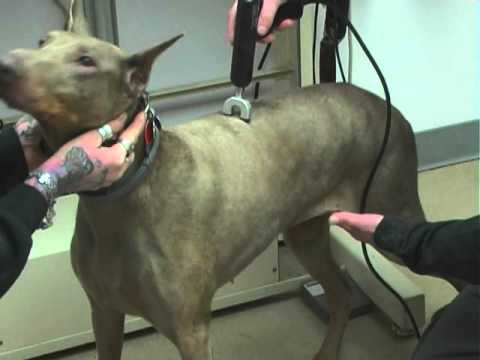
Related Videos



How the Condition Progresses Over Time
Dancing Doberman Disease is progressive in many affected dogs, though the rate of progression varies significantly between individuals.
The typical progression follows this pattern:
- Early stage: Intermittent flexion of one hind limb while standing. Subtle and easy to miss.
- Established stage: Clear alternating lifting of both hind limbs. The classic dancing presentation. No significant weakness yet.
- Advancing stage: The involuntary movements become more pronounced. Mild muscle wasting begins in the hind limbs.
- Later stage: Weakness becomes apparent alongside the movement disorder. Coordination may be affected.
- Advanced stage: Significant muscle atrophy, difficulty maintaining a standing position, reduced hind limb strength.
Some dogs remain in the early to established stage for years without dramatic deterioration. Others progress more rapidly. There is no reliable way to predict which course an individual dog will follow.
Why This Happens: The Real Cause Behind the Disorder
The honest answer is that the exact cause of Dancing Doberman Disease is not fully understood.
What research has established:
- The condition involves degeneration of peripheral nerves, specifically the sensory and motor nerves supplying the hind limbs
- The gastrocnemius muscle, which runs along the back of the lower hind leg, shows consistent changes in affected dogs
- There is a strong breed predisposition in Doberman Pinschers, suggesting a genetic component
- The degeneration affects the nerves’ ability to regulate normal muscle tone and movement, leading to the uncontrolled flexion pattern
What remains unclear:
- The specific genetic mutation or trigger responsible
- Why the condition primarily affects the hind limbs and not the forelimbs
- Why some Dobermans are affected and others are not despite similar backgrounds
The condition was first described and documented in Dobermans in the 1980s, and while more is understood now than then, a definitive cause has not been confirmed.
What Happens Inside the Nervous System During These Movements
Normal standing requires continuous, balanced nerve signaling between the spinal cord and the muscles of the limbs. That signaling maintains muscle tone without triggering movement.
In Dancing Doberman Disease:
- Peripheral nerve degeneration disrupts the normal sensory feedback from the hind limbs to the spinal cord
- Without accurate sensory input, the spinal cord cannot properly regulate motor output to the muscles
- The muscles of the hind limb receive abnormal, unregulated signals
- The result is the rhythmic, involuntary flexion that the dog cannot control or suppress
- The gastrocnemius muscle appears to be particularly affected by these abnormal signals
- Over time, the nerves degenerate further, reducing both motor control and muscle maintenance, leading to atrophy
The movement is not the dog choosing to lift their leg. It is the nervous system misfiring in a very specific, predictable pattern because its regulatory circuit has been damaged.
Why Dobermans Are Most Commonly Affected
Dancing Doberman Disease is almost exclusively reported in Doberman Pinschers. Isolated cases in other breeds have been documented, but they are exceptionally rare.
The breed predisposition strongly suggests a genetic basis, though the specific gene or genes involved have not been identified through published research. The condition appears in both male and female Dobermans, and onset typically occurs between six months and seven years of age, with most cases appearing in young to middle-aged adults.
The fact that the condition is so breed-specific is both a clue about its genetic nature and a reason it remains relatively poorly understood. The limited population of affected dogs makes large-scale research challenging.
Owners of Dobermans, particularly those with a family history of the condition in their dog’s lineage, should be especially attentive to early signs of hind limb movement changes.
Conditions That Can Look Similar but Are Not the Same
Several conditions produce hind limb movement abnormalities that can be confused with Dancing Doberman Disease.
- Ataxia: Produces incoordination and stumbling during movement, not rhythmic standing-still flexion. Ataxia affects gait quality; Dancing Doberman Disease primarily affects standing posture.
- IVDD: Causes pain, weakness, and coordination loss from spinal cord compression. Dogs with IVDD show pain responses and progressive weakness rather than isolated involuntary flexion.
- Generalized muscle tremors: Affect the whole body or multiple limb groups simultaneously, rather than the specific alternating hind limb pattern of Dancing Doberman Disease.
- Hyperekplexia: An exaggerated startle response causing sudden muscle stiffness, triggered by external stimuli rather than occurring spontaneously during standing.
- Orthopedic pain: Hip dysplasia or stifle disease can cause weight shifting and reluctance to stand, but these are accompanied by pain responses, joint changes on imaging, and altered gait even during walking.
The exploration of broader movement and neurological conditions is well covered within the wider dog medical conditions library for owners seeking to understand the full differential picture.
How Vets Identify This Rare Condition
There is no single definitive test for Dancing Doberman Disease. Diagnosis is primarily clinical.
- Direct observation: Watching the dog stand for several minutes to document the alternating hind limb lifting pattern
- Video documentation: Owners filming the behavior at home is extremely valuable, as the movement may not occur consistently in a clinic environment
- Full neurological examination: To identify whether the condition is isolated to this movement disorder or accompanied by other neurological deficits
- Electromyography (EMG): Electrical testing of muscle activity can reveal abnormal spontaneous activity in the gastrocnemius and other hind limb muscles, supporting the diagnosis
- Muscle biopsy: In some cases, biopsy of the gastrocnemius reveals characteristic changes consistent with denervation
- Ruling out other causes: Spinal imaging, blood work, and orthopedic examination to exclude IVDD, metabolic disease, and joint disorders
Because this is a rare condition, it may not be considered immediately by a vet unfamiliar with it. Bringing video evidence and raising the condition by name can significantly accelerate diagnosis.
Why There Is No Direct Cure
There is currently no treatment that stops or reverses the neurological degeneration causing Dancing Doberman Disease.
No medication has been shown to halt the progression. No surgical intervention addresses the underlying nerve degeneration. The condition is managed, not cured, and the goal of management is maintaining quality of life for as long as possible.
This is not a reason to abandon the investigation or give up on the dog. Many affected Dobermans live comfortably for years with the condition, particularly those whose progression is slow. But owners must enter management with realistic expectations about what is and is not possible.
How Management Focuses on Quality of Life
Without a curative option, management centers on slowing functional decline and maintaining comfort.
- Controlled exercise: Regular, gentle physical activity maintains muscle strength for longer. High-impact or intense exercise that could accelerate muscle fatigue is avoided.
- Physiotherapy: Targeted exercises designed to maintain hind limb muscle tone and joint flexibility.
- Supportive surfaces: Non-slip flooring and padded resting areas reduce the risk of falls as weakness progresses.
- Weight management: Maintaining an ideal body weight reduces the load on weakening hind limbs.
- Regular monitoring: Periodic neurological assessments track whether the condition is stable or progressing, allowing management adjustments.
- Pain assessment: While early stages are not painful, advancing muscle atrophy and altered posture may create discomfort that requires management in later stages.
The VOSD dog care and health resources platform provides broader guidance on managing dogs with progressive neurological conditions, which is directly applicable to the long-term care of dogs with Dancing Doberman Disease.
Related Products


Dancing Doberman Disease vs Muscle Tremors vs Weakness
| Feature | Dancing Doberman Disease | Muscle Tremors | Hind Limb Weakness |
|---|---|---|---|
| Movement type | Alternating hind limb flexion | Rhythmic shaking of affected area | Reduced limb function |
| Occurs when | Standing still | Rest or activity | During movement |
| Conscious control | No | No | Partial |
| Pain in early stages | No | Variable | Often yes |
| Breed predisposition | Doberman strongly | Various | Various |
| Progression | Slow to moderate | Depends on cause | Variable |
When This Becomes a Serious Concern
Most cases of Dancing Doberman Disease progress slowly enough that the dog manages well for extended periods. But certain signs indicate that the condition has advanced to a point requiring prompt reassessment.
Act urgently if:
- The dog can no longer stand comfortably for more than a few minutes
- Significant muscle wasting is visible in the hind quarters
- The dog begins falling or collapsing when trying to stand
- Coordination during walking deteriorates alongside the standing movements
- New neurological signs appear, such as forelimb involvement, altered mentation, or loss of bladder control
- Progression from mild to severe signs occurs rapidly over days to weeks
Rapid progression is not typical of Dancing Doberman Disease alone. If deterioration is sudden or severe, another concurrent condition must be investigated.