
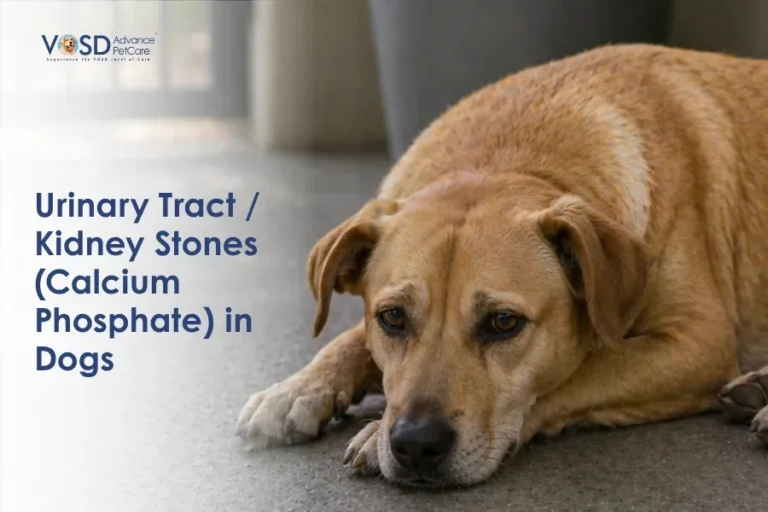
They form silently. There is no visible warning, no sudden dramatic sign, and often no obvious discomfort until the stones have grown large enough to irritate tissue, obstruct urine flow, or begin damaging the kidneys they are sitting within.
Calcium phosphate stones are one of the less commonly discussed types of urinary stones in dogs, but their tendency to form in the kidney rather than the bladder, their resistance to dietary dissolution, and their association with underlying metabolic disorders make them a clinically significant condition that demands careful management. Understanding how they form, what they do, and how they are detected is the foundation of catching them before they cause the kind of damage that cannot be undone.
What These Stones Really Are
Calcium phosphate uroliths, sometimes referred to as apatite stones, are mineral deposits that form within the urinary tract when urine becomes supersaturated with calcium and phosphate ions to the point where these minerals begin to precipitate out of solution and crystallise.
Unlike some other stone types that form primarily in the bladder, calcium phosphate stones have a particular predilection for forming in the kidney itself, where they are called nephroliths. Kidney stones are more clinically complex than bladder stones for several reasons. They are less accessible to surgical or minimally invasive removal techniques. They sit within the organ they are damaging. And they can cause progressive renal scarring and dysfunction that accumulates over time before any clinical signs become apparent to the owner.
The urinary tract involvement does not stop at the kidney. Stones that form in the kidney can remain there, but they can also move. A stone that migrates from the kidney into the ureter, the narrow tube connecting the kidney to the bladder, creates a potentially complete obstruction of urine flow from that kidney. A stone that reaches the bladder may lodge in the urethra during urination, producing the acute, painful, life-threatening blockage that represents the most urgent presentation of urinary stone disease.
What You May Notice, Or Miss Completely
One of the most clinically important features of calcium phosphate stones in dogs is that they are frequently asymptomatic in their early stages. The stones are forming and growing within the kidney without producing any signs that the owner can detect, and without causing the dog obvious pain or discomfort.
When symptoms do appear, they reflect either irritation of the urinary tract lining by the stones or the consequences of obstruction.
- Blood in the urine, which may appear as visibly red or pink urine, or may only be detectable on laboratory analysis as microscopic haematuria
- Straining to urinate or producing urine in small, frequent amounts rather than normal volumes
- Frequent urination with an urgency that reflects irritation of the bladder or urethra
- Vomiting and lethargy when stone disease has reached the point of affecting kidney function or when obstruction is beginning
- Abdominal or back pain, which dogs may show as reluctance to be touched in the flank area, hunched posture, or reluctance to move normally
The pattern of blood in the urine, combined with changes in urination behaviour in any dog, warrants veterinary assessment without delay. The absence of pain does not mean the absence of a significant problem.
Why These Stones Form: The Real Causes
Calcium phosphate stone formation is driven by specific urinary chemistry conditions rather than by infection or dietary factors alone.
- Alkaline urine is the single most important environmental factor for calcium phosphate crystallisation. These minerals precipitate preferentially in an alkaline urinary environment. Dogs whose urine is persistently alkaline, whether from diet, metabolic disease, or urinary tract infection with certain bacteria, are at elevated risk
- Hypercalciuria, the presence of abnormally high concentrations of calcium in the urine, provides the mineral substrate for stone formation. This can result from increased absorption of calcium from the gut, decreased reabsorption of calcium by the kidney tubules, or excessive mobilisation of calcium from bone
- Hyperparathyroidism and other conditions that raise blood calcium levels produce secondary elevation of urinary calcium and are a recognised cause of calcium-containing stone formation
- Low water intake concentrates the urine, increasing the concentration of calcium and phosphate ions and pushing the urine closer to the supersaturation threshold at which crystallisation begins
- Chronic urinary tract infection with certain bacterial species that produce urease can alkalinise the urine sufficiently to favour calcium phosphate precipitation alongside struvite formation
Related Videos


How These Stones Develop Inside the Body
The mechanism of calcium phosphate stone formation follows a logical chemical progression that explains both why stones form and why they are so difficult to dissolve once established.
Healthy urine contains dissolved calcium and phosphate ions held in solution by the balance of pH, ionic concentration, and inhibitory molecules that normally prevent crystallisation. When this balance is disrupted, specifically when the product of calcium concentration and phosphate concentration in the urine exceeds the saturation threshold, the ions begin to precipitate out of solution as microscopic crystals.
These initial crystals are tiny and pass in the urine without causing any problem. The critical transition occurs when conditions favour the aggregation of individual crystals into larger clusters, and when those clusters begin to adhere to the cells of the renal tubules or collecting ducts within the kidney rather than being flushed out in the urine stream. Once anchored to the kidney tissue, the stone grows as additional mineral layers deposit around the existing crystal matrix.
As the stone grows, it begins to physically damage the tissue it rests against, producing local inflammation, scarring, and progressive impairment of the function of the nephrons it is displacing or compressing. This is why long-standing kidney stones produce cumulative renal damage even in the absence of obstruction.
When a stone or fragment migrates into the ureter, its sharp edges and the inflammatory response it triggers produce the intense, colicky pain associated with ureteral stones, and if it lodges completely, it blocks all urine flow from that kidney.
The earlier stage of urine crystals in dogs represents the pre-stone phase of this process, where the mineral precipitation has begun but has not yet aggregated into stones capable of causing obstruction or significant tissue damage. Detecting and addressing crystalluria before stone formation occurs is the most effective form of prevention.
Different Locations Where Stones Can Form
The location of calcium phosphate stone formation determines the clinical presentation and the urgency of management.
Kidney stones (nephroliths) form within the renal pelvis or collecting system of the kidney. They may remain clinically silent for extended periods but cause progressive local damage and carry the risk of obstructing urine flow from the kidney if they grow large or migrate.
Ureteral stones represent the most acutely dangerous location. The ureter is a narrow, muscular tube, and even a small stone lodged within it can produce complete obstruction of urine flow from the affected kidney. Ureteral obstruction causes severe pain and, if not relieved, leads to rapid deterioration of function in the obstructed kidney.
Bladder stones (cystioliths) sit within the bladder and cause chronic irritation of the bladder wall, producing frequent urination, blood in urine, and straining that owners typically notice first. While serious, bladder stones are generally more accessible to treatment than kidney or ureteral stones.
Urethral stones are the cause of the acute urinary blockage emergency described in detail in VOSD’s guide to urinary tract blockage in dogs, where a stone migrating from the bladder becomes lodged in the urethra and prevents all urine from exiting the body.
Which Dogs Are More Likely to Develop Them
Calcium phosphate stones are less breed-specific in their distribution than some other stone types, but certain risk profiles are clearly associated with their development.
- Dogs with primary hyperparathyroidism, a tumour of the parathyroid gland that drives excess calcium production, are at high risk of calcium-containing stone formation and should be monitored for urinary tract involvement
- Dogs with idiopathic hypercalcaemia, where blood calcium is elevated without an identifiable cause, represent another at-risk population
- Dogs with chronic urinary tract infections that alkalinise the urine create conditions that favour calcium phosphate precipitation alongside struvite stone formation
- Dogs with chronically low water intake, particularly those fed exclusively dry food without encouragement to drink, maintain more concentrated urine that is more susceptible to supersaturation
How Vets Detect Stones Before They Become Dangerous
Detecting calcium phosphate stones, particularly those in the kidney, before they produce clinical signs or cause significant damage requires active investigation rather than waiting for symptoms to appear.
- Urinalysis is the most accessible initial investigation, assessing urine pH, specific gravity, and the presence of crystals. Persistently alkaline urine with calcium phosphate crystals is a significant finding that warrants further imaging
- Blood tests assess calcium and phosphorus levels in the bloodstream, parathyroid hormone where hyperparathyroidism is suspected, and kidney function markers including creatinine and urea
- Radiography identifies radio-opaque stones within the urinary tract. Calcium phosphate stones are typically visible on plain radiographs due to their mineral density
- Ultrasound provides a more detailed assessment of stone location, size, and number, and allows evaluation of the kidney architecture and the degree of any renal pelvis dilation, indicating obstruction. Ultrasound also detects stones that may not be visible on plain radiographs due to their position
Regular urinalysis and blood testing in dogs known to be at risk, including those with chronic urinary tract infections, metabolic disorders, or a previous stone episode, allows early detection of recurrent crystal formation before new stones have developed.
Treatment: Why These Stones Often Need Removal
The management of calcium phosphate stones differs importantly from the management of struvite stones, and owners need to understand this distinction to have realistic expectations.
Struvite stones, which form secondary to infection, can often be dissolved through elimination of the infection combined with a specific therapeutic diet. Calcium phosphate stones cannot reliably be dissolved through dietary manipulation alone. The chemical composition of apatite stones makes them resistant to the urinary acidification strategies used to dissolve other stone types.
This means that established calcium phosphate stones in the kidney or bladder typically require physical removal rather than dissolution.
Surgical removal of bladder stones through cystotomy is the most straightforward approach when stones are located in the bladder and are of sufficient size or number to be causing clinical problems.
Ureteral and kidney stones are more surgically challenging. Depending on their location, size, and the dog’s overall condition, options include minimally invasive procedures to fragment or remove stones, surgical ureterotomy, or in cases where the affected kidney has lost significant function, nephrectomy if the other kidney is functioning adequately.
Medical management of the underlying cause is an essential component of treatment that must accompany stone removal to prevent rapid recurrence. Addressing hyperparathyroidism, managing hypercalcaemia, treating concurrent urinary tract infection, and implementing dietary and hydration strategies to reduce urinary calcium and alkalinity are all components of long-term management.
Related Products


What Recovery Looks Like and Why Recurrence Is Common
Dogs whose calcium phosphate stones are identified and treated before significant renal damage has occurred generally recover well. Kidney function that was impaired by back-pressure or stone-associated inflammation often improves following stone removal and management of the underlying cause.
However, the recurrence rate for calcium phosphate stones is significant, particularly in dogs where the underlying metabolic driver, such as hyperparathyroidism or idiopathic hypercalcaemia, has not been fully resolved. Stones will reform in the same chemical environment that produced the originals.
This is why long-term management following stone removal is as important as the removal itself. Regular urinalysis to monitor urine pH and crystal content, periodic imaging to check for early stone recurrence, and ongoing management of any identified metabolic condition are the foundations of preventing the cycle of stone formation from repeating.
Complications That Can Turn Dangerous
Calcium phosphate stones that are not identified and managed carry a predictable progression of complications.
- Urinary obstruction when stones migrate to the ureter or urethra, producing the acute, life-threatening situation described in VOSD’s guide to urinary tract blockage in dogs
- Progressive kidney damage from the chronic pressure and inflammatory effects of stones sitting within the renal pelvis, leading to fibrosis and permanent loss of nephron function over time
- Recurrent urinary tract infections as stones provide a physical surface for bacterial colonisation that is protected from the antibiotic concentrations needed to clear the infection, producing persistent, difficult-to-treat infections
When kidney damage reaches a critical threshold, the resulting kidney failure can produce the systemic collapse that represents the most severe endpoint of untreated urinary stone disease. Understanding how systemic collapse presents in dogs is an important context for recognising when urinary stone disease has progressed to this level of severity, and VOSD’s guide to shock in dogs covers the clinical signs and emergency management of this life-threatening state.
In rare cases, the systemic inflammation and toxin accumulation associated with severe urinary tract disease can contribute to neurological complications. The broader context of how systemic infections and inflammatory conditions can affect neurological function is explored in VOSD’s guide to brain inflammation in dogs, which illustrates how systemic disease can extend its reach to the central nervous system in severely affected animals.
Calcium Phosphate vs Other Stone Types
| Stone Type | Urine pH | Primary Location | Dissolvable? | Key Cause |
|---|---|---|---|---|
| Calcium phosphate | Alkaline | Kidney, bladder | No | Hypercalciuria, metabolic disease |
| Struvite | Alkaline | Bladder | Yes | Urinary tract infection |
| Calcium oxalate | Acidic to neutral | Bladder | No | Dietary, metabolic |
| Urate | Acidic | Bladder, urethra | Sometimes | Liver disease, breed predisposition |
The key clinical distinction between calcium phosphate and struvite stones is particularly important because both form in alkaline urine and can coexist, but struvite responds to dissolution protocols that calcium phosphate does not. Accurate stone type identification through laboratory analysis of retrieved stone material is therefore essential for guiding long-term management.
When to See a Vet Without Delay
Any of the following signs warrants a same-day veterinary assessment.
- Blood visible in the urine or urine appearing pink, red, or brown
- Straining to urinate or producing only small amounts of urine frequently
- Any episode of complete inability to urinate, which is an immediate emergency
- Vomiting combined with lethargy and changes in urination behaviour
- Any dog with a known history of urinary stones showing new urinary signs
Dogs with known metabolic conditions associated with hypercalcaemia, including hyperparathyroidism, should have regular urinalysis and periodic imaging even in the absence of symptoms, as the silent formation of kidney stones in these dogs is a recognised and preventable complication of the underlying disease.